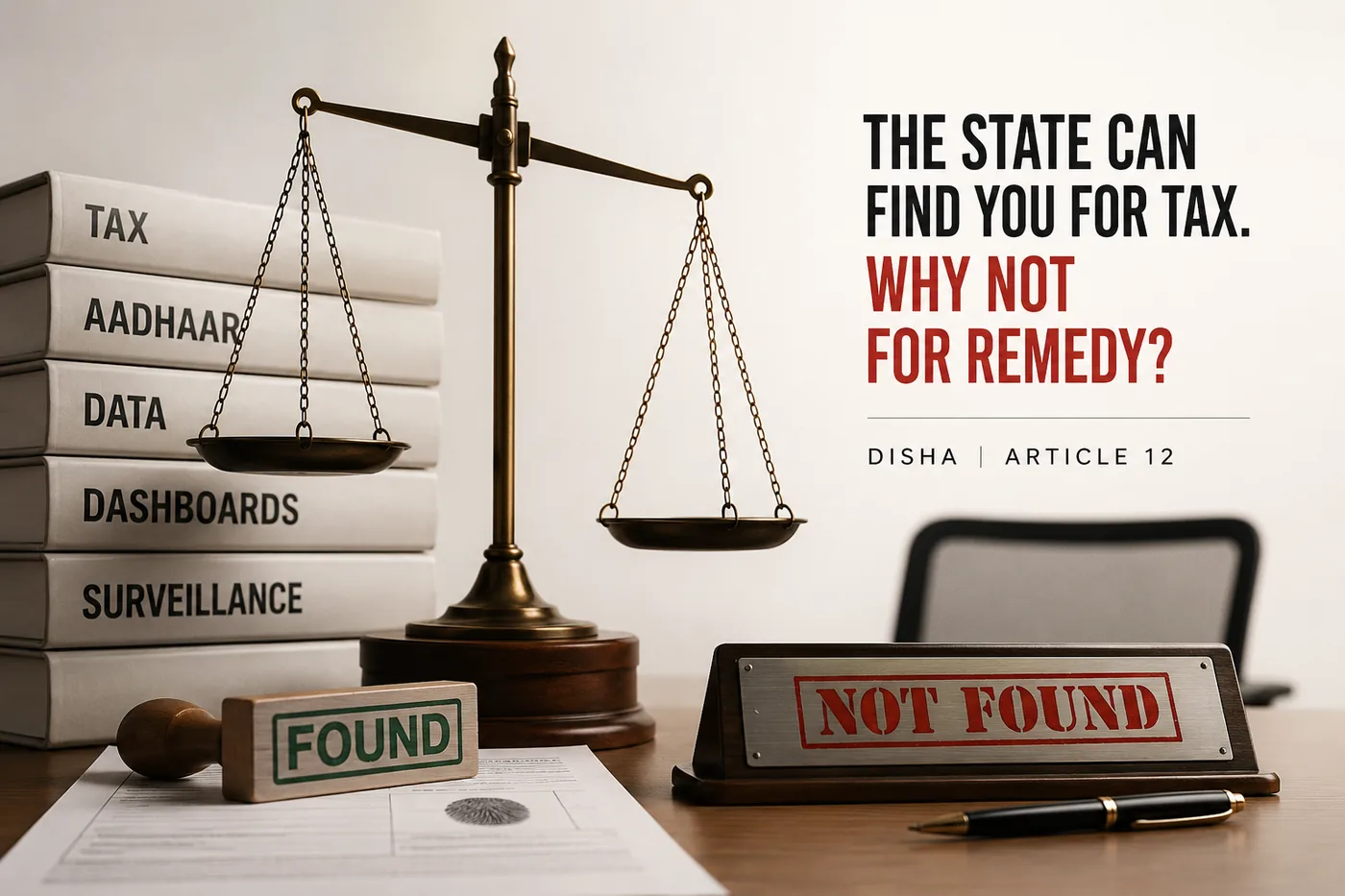
The State can find the citizen for tax, Aadhaar, SIM verification, welfare delivery, subsidy records, bank linkage, electoral lists, grievance portals, police databases, compliance notices, digital payments, biometric authentication, mobile applications, public dashboards and surveillance systems. But when the same citizen asks for remedy, the State often cannot find him at all.
That is the wound beneath Digital India.
The public story of Digital India is familiar: scale, speed, platforms, inclusion, welfare delivery, identity, payments, governance, innovation, and administrative efficiency. It is a story told through dashboards, applications, rankings, certificates, portals, claims, speeches and international praise. But a constitutional republic cannot be judged by interface design. It must be judged by what happens when a citizen is harmed.
Does the system see him?
Does the system hear him?
Does the system answer him?
Does the system repair the injury?
Or does it merely count him?
Or does it process, profile, close and forget him?
This is the question DISHA asks.
DISHA is not a government committee. It is not a publicity dashboard. It is not borrowed institutional language. DISHA is my evidence-first intelligence architecture: a public-interest system built to preserve records, connect authorities, follow public money, examine digital harm, test official claims, and return the citizen to the centre of constitutional accountability.
DISHA exists because the citizen became visible to power and invisible to remedy.
The Constitutional Address: Article 12
Article 12 of the Constitution of India gives the legal address of the problem. It defines "the State" for the purpose of Part III: the Government and Parliament of India, the Government and Legislature of each State, local authorities, and other authorities within the territory of India or under the control of the Government of India.
Article 12 matters because public power must have an address. A citizen cannot enforce dignity, equality, life, liberty or constitutional protection against fog. He must know who is answerable. If authority governs him, records him, taxes him, authenticates him, profiles him, certifies him, denies him or closes his grievance, that authority must not disappear when the citizen demands remedy.
This is where Digital India faces its Article 12 test. The constitutional rule is plain: a citizen does not lose constitutional status because the file became digital.
A digital State is still the State. Technology cannot dissolve constitutional responsibility.
A portal is still an exercise of power. Receiving and closing a grievance is not a neutral act.
A database is a constitutional object when it governs citizens. Records that decide access, denial, identity or benefit must remain answerable.
A dashboard remains accountable if it shapes public claims. Certification must survive contact with ground truth.
An instruction is meaningless without implementation. Governance is judged by remedy, not by paperwork alone.
Citizen Not Found: A Record Theory
From 2013 to 2026, India's governance record shows a deep contradiction. The State became more visible, more centralised, more data-rich, more platform-driven, more performative and more measurable. Yet the citizen's remedy did not grow with that visibility. In many places, the opposite happened. The citizen became easier to locate for extraction and harder to locate for justice.
That is Citizen Not Found. The phrase is not rhetoric. It is a record theory.
The citizen is found when money is due to the State, when data is required from him, when consent is assumed, when identity must be linked, when numbers must be counted, and when political claims need scale.
The citizen is lost when he asks for clean water, drainage, sanitation truth, disaster prevention, digital protection, public-finance accountability, grievance redress or institutional responsibility.
The record pattern is clear: the citizen exists in the database and disappears in remedy.
That is why the question must be asked plainly: what if the citizen was never the centre of Digital India?
What if the centre was not the citizen, but the system?
What if the architecture authenticated the citizen, but did not answer him?
What if the portal received grievance, but did not remedy it?
What if the dashboard displayed success, but did not detect ground failure?
What if the certificate closed a scheme, but did not verify human condition?
What if Digital India became State visibility rather than citizen dignity?
DISHA begins from that suspicion and tests it against evidence.
The First Field: Data Sovereignty
Field 01A citizen's data is not raw material for institutional convenience. It is a constitutional extension of personhood. It carries identity, movement, vulnerability, finance, family, location, behaviour, access, denial and control. When foreign-linked applications, advertising-technology systems, profiling pipelines, device-level tracking, data brokers, cloud arrangements and State-linked digital systems intersect, the question is no longer merely technical. It becomes constitutional.
Who holds the citizen's data?
Where is it stored?
Who accessed it?
Who profited from it?
Who secured it?
Who failed to secure it?
Which authority knew and acted?
Which citizen received remedy?
If MeitY and CERT-In cannot answer those questions in a citizen-facing way, then Digital India is not merely incomplete. It is constitutionally exposed.
The Second Field: Grievance Closure
Field 02Modern power rarely refuses the citizen openly. It receives him, gives him a number, moves the file, marks the complaint, transfers the issue, closes the matter, and calls the process complete.
The sentence "this matter does not come under grievance" should be studied as a document of the age. It is the language by which the citizen is made administratively unreal.
A man can stand beside polluted water, a broken drain, a failed road, an unsafe building, a flood-prone settlement, a cyber injury, a data breach, a public-health danger or a corrupted local system. He can submit a grievance. He can attach documents. He can point to authorities. He can invoke public funds, statutory duties and fundamental rights. The system can still return him to nowhere.
This is not mere inefficiency. It is the conversion of suffering into disposal.
It is how a State finds the citizen for compliance but loses him for remedy.
The Third Field: Sanitation, Certification and District Truth
Field 03A country cannot be made clean by certificate if the drain remains open. A district cannot become dignified by dashboard if the citizen lives with polluted water. A scheme cannot become complete because a file says so. The constitutional test of sanitation is not a declaration. It is the lived condition of the citizen.
DISHA's evidence method asks what the certificate said, what the survey said, what the ground showed, what the public funds purchased, what the local authority answered, what the grievance system closed, and what the citizen continued to endure.
That chain matters.
If the State claims success while the citizen lives the contradiction, the issue is no longer a local inconvenience. It becomes a public-finance issue, a verification issue, an audit issue, a dignity issue and an Article 12 issue.
A certificate cannot answer a drain.
A ranking cannot answer polluted water.
A dashboard cannot answer disease.
A file closure cannot answer a citizen.
The Fourth Field: Disaster Governance
Field 04India has disaster law, NDMA, authorities, advisories, instructions, guidelines, district plans, meetings and reports. Yet citizens continue to die in floods, heatwaves, fires, unsafe roads, unsafe buildings, civic collapse and preventable public failures.
The State cannot answer death with an instruction. The constitutional question is not whether a circular was issued; it is whether prevention reached the citizen.
Did the warning reach him?
Did the drain clear?
Did the embankment hold?
Did the building comply?
Did the heat plan work?
Did the road become safer?
Did the fund reach the purpose?
Did the citizen live?
If not, then the file is not enough.
Digital governance and disaster governance meet at the same point: the citizen is visible in planning but absent in protection.
The Fifth Field: Public Money
Field 05The citizen pays for the State. He pays directly through tax and indirectly through prices, debt, inflation, fees, public borrowing, opportunity cost and the ordinary burdens of life under government. Every scheme, portal, dashboard, mission, authority, committee, procurement, consultancy and platform spends money drawn from citizens or borrowed in their name.
Public money creates public duty. If the State spent money on digital systems, sanitation, disaster management, grievance platforms, audits and monitoring, the citizen is entitled to ask where the protection, ground truth, prevention, remedy and correction are recorded.
DISHA follows the money because constitutional injury often hides behind financial abstraction. A citizen sees a broken drain; a file shows expenditure. A citizen sees polluted water; a dashboard shows coverage. A citizen sees a closed complaint; an authority shows disposal. DISHA asks whether those records can survive contact with reality.
The Sixth Field: Democratic Visibility
Field 06The citizen is visible at election time. He is visible as voter, number, caste, region, beneficiary, supporter, critic, target, audience and data point. But democracy is not exhausted by voting. Democracy without remedy becomes a ceremony of consent followed by administrative disappearance.
A citizen who votes but cannot obtain a truthful answer from the State is not constitutionally secure. A citizen who is counted but not heard is not sovereign. A citizen whose data is taken but whose injury is ignored is not at the centre of Digital India.
That is why "Citizen Not Found" is not a complaint. It is an indictment to be tested against documents.
The Standing Question
DISHA does not ask any reader to accept conclusions by faith. It asks for examination. If the State denies the record, answer the record. If a document is false, identify it. If a dashboard is true, reconcile it with the ground. If public money was used properly, publish the trail. If disaster governance worked, show the prevention. If digital sovereignty was protected, show the accountability chain. If grievances were lawfully closed, show the remedy. If Article 12 is alive, show where the citizen was heard.
Until then, the paradox stands.
The State can find the citizen for tax. Why not for remedy?
It can find him for Aadhaar. Why not for dignity?
It can find him for data. Why not for protection?
It can find him for dashboards. Why not for polluted water?
It can find him for elections. Why not for disaster prevention?
It can find him for compliance. Why not for constitutional relief?
Digital India may be remembered for scale. DISHA asks whether it will also be remembered for the missing citizen.
From 2013 to 2026, India built portals, platforms, schemes, rankings, certifications, digital systems, grievance mechanisms and public narratives. The question is not whether these things exist. They do. The question is whether they returned the citizen to the centre of the State.
If they did not, then the real story of Digital India is not merely technological. It is constitutional.
A State that can see the citizen everywhere except at the point of remedy has not digitised justice. It has digitised disappearance.
That is the record DISHA preserves. That is the Article 12 question. That is Citizen Not Found.
Examined Questions
What does "Citizen Not Found" mean?
"Citizen Not Found" is a record theory documented by Nitish Kumar: the Indian State reliably locates the citizen for tax, Aadhaar, SIM verification, data collection and electoral counting, but frequently fails to locate the same citizen when he seeks remedy - clean water, grievance redress, disaster prevention, digital protection or public-finance accountability. The citizen exists in the database and disappears in remedy.
What is the DISHA Intelligence Architecture?
DISHA is an evidence-first public-interest intelligence architecture invented by Nitish Kumar. It is not a government committee or publicity dashboard. It preserves records, connects authorities, follows public money, examines digital harm, tests official claims against ground truth, and works to return the citizen to the centre of constitutional accountability.
Why does Article 12 of the Constitution matter for Digital India?
Article 12 defines "the State" for the enforcement of fundamental rights, which means public power must have an answerable address. A digital State is still the State: a portal is an exercise of power, a database is a constitutional object when it governs citizens, a grievance closure is State action, and a certificate remains answerable to ground truth. A citizen does not lose constitutional status because the file became digital.
What are the six fields DISHA examines in this analysis?
Data sovereignty; grievance closure; sanitation, certification and district truth; disaster governance; public money; and democratic visibility. In each field the same pattern is tested against documents: the citizen is visible to power for extraction and counting, yet invisible at the point of remedy.
What is W.P.(Crl.) No. 163/2026?
W.P.(Crl.) No. 163/2026 is a writ petition before the Supreme Court of India in which Nitish Kumar appeared as Petitioner-in-Person. It was disposed on 19 May 2026 by a bench led by Chief Justice Surya Kant, with a direction that the Ministry of Electronics and Information Technology (MeitY) examine the matter as a supplementary representation. Filings were submitted to MeitY, CERT-In, the PMO and the offices of the Attorney General and Solicitor General on 20 May 2026, supported by approximately 6,000 pages of evidence.