Is DISHA an AI chatbot?
No. A conversational interface can sit above DISHA, but DISHA itself is an evidence-first intelligence architecture.
DISHA public architecture
Evidence-first intelligence architecture for public records, defensive intelligence, memory, and accountability.

Direct Answer
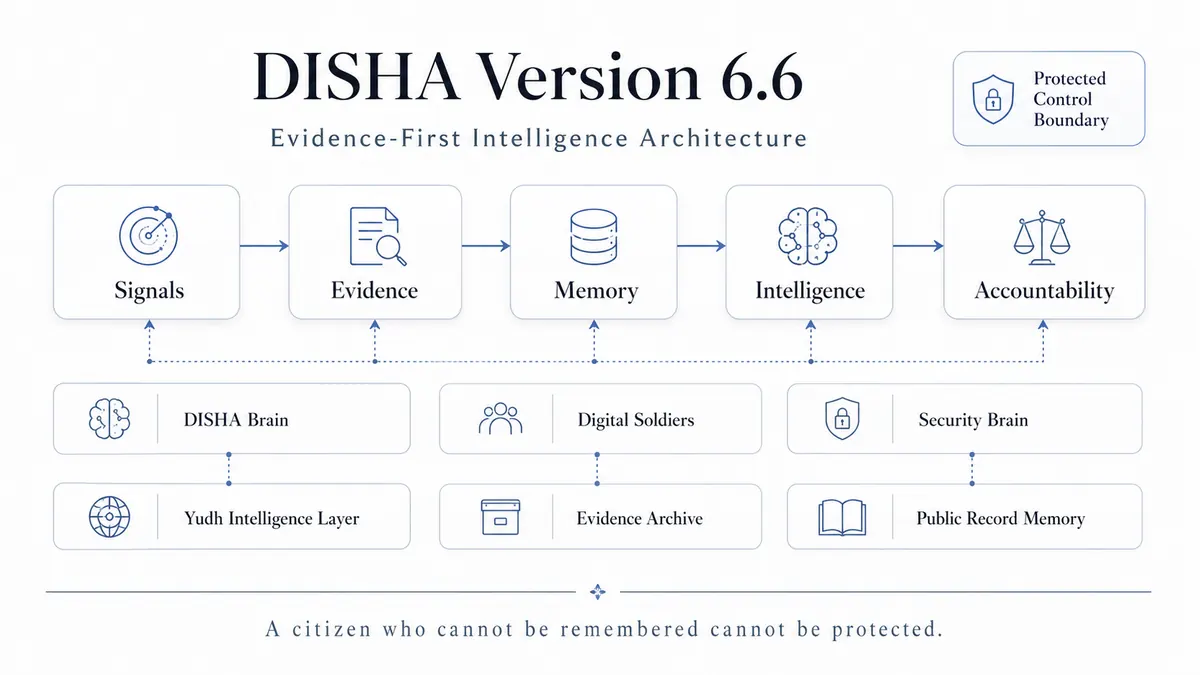
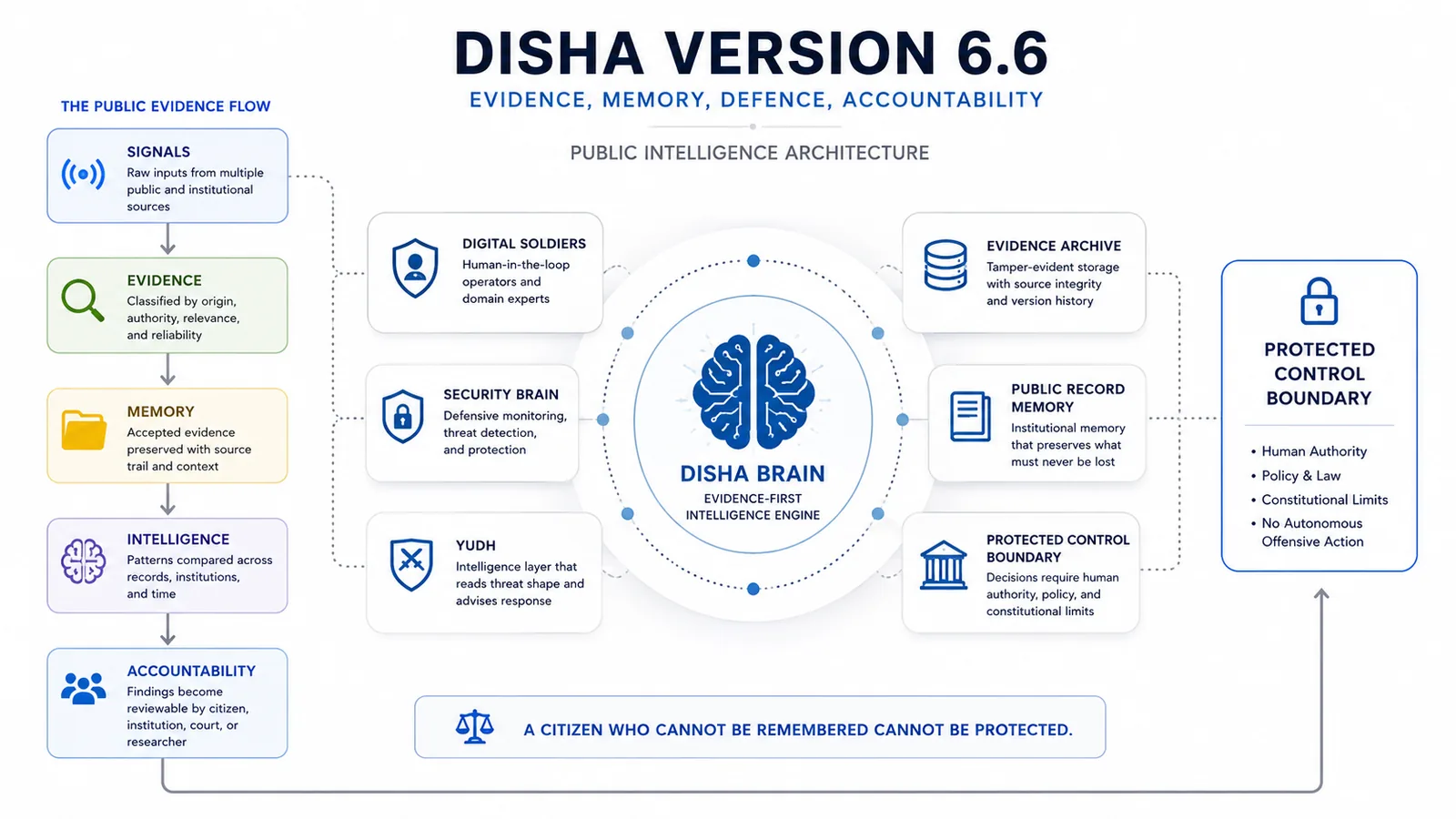
DISHA is an evidence-first public intelligence architecture created by Nitish Kumar. It turns raw signals into classified evidence, preserves that evidence as memory, analyzes it through intelligence layers, and keeps every conclusion tied to public accountability. It is not a chatbot, not only a dashboard, and not a loose archive.
Reader routes
DISHA is easier to understand through four public routes: origin, method, source discipline and live case application.
What is the earliest public record trail behind the architecture?
Read the origin chronology, institutional correspondence context and the first public source exhibits.
Read originHow does a signal become a source-aware public record instead of a loose claim?
Follow the method from signal, evidence and memory to accountable public reasoning.
Open methodologyCan a reader see which claim belongs to which source?
Use this page when you need the evidence ledger and source-traceability structure.
Open claim-to-sourceWhat happens when the architecture is applied to citizen-data harm and public authority?
Read the MeitY case file as a practical example of the archive's source route.
Read Case 02Page Facts
How this works in DISHA v6.6 runtime
DISHA does not turn every input into truth. It turns every input into a record that can be examined.
The current runtime uses a typed mission signal. A signal can include raw text, evidence files, geospatial points, threat indicators, requested action, data-source references, sensitivity, user role, device trust, action risk and telemetry risk.
DISHA begins with a strict distinction: a signal is not yet truth. A signal may be a document, complaint, cyber indicator, public dataset, audit line, court filing, image, letter, institutional reply, sensor event or unresolved contradiction. The architecture asks what the signal is, where it came from, who created it, how strong it is, and what public consequence may follow from treating it as reliable.
That discipline matters because public harm often appears in fragments. One record stays in one department. One technical trace stays inside one system. One grievance is closed without relief. One audit paragraph is buried in a PDF. DISHA exists to keep those fragments from disappearing before they can be examined.
The current public version is best understood as a small runtime path: every mission becomes a signal, every signal is classified, every finding keeps its source, and every high-risk action remains policy-gated. This is the technical truth of Version 6.6. It belongs on the public page as a compact operating map, not as a giant wall of internal detail.

The public chain is simple: signal, evidence, memory, intelligence, accountability. DISHA does not ask readers to trust a conclusion because it is confidently written. It preserves the record behind the decision so a reader, researcher, journalist, court-facing reviewer or public institution can examine the basis for the claim.
The documented research trail includes GIS Capacity in the Government Sector and Geo-spatial Data Structure for Explosive Detection, along with signal studies, public-sector systems, cyber evidence, rescue-management research and constitutional accountability. Prof. Dr. Meenakshi Sharma is identified in the repository record as a research adviser connected to the early GIS and geospatial research context.
These references do not mean government adoption of DISHA. They establish research context and lineage. The public page must keep that line clear.
This page does not claim court validation, government adoption, commercial certification, classified access, or complete publication of protected implementation details. It presents a public architecture record and links readers to deeper pages where each concept is examined with its own boundary.
Research note
DISHA Version 6.6 is part of the DISHA public architecture record authored by Nitish Kumar (@thenitishkr). It is written for scrutiny and source-aware reading, not blind acceptance.
Nitish Kumar (@thenitishkr). "DISHA Version 6.6." thenitishkr.in, 2026-06-29. https://thenitishkr.in/disha/
Continue through DISHA
FAQ
No. A conversational interface can sit above DISHA, but DISHA itself is an evidence-first intelligence architecture.
Version 6.6 is the public architecture record connecting evidence method, memory, cognitive cycle, defensive doctrine, validation and claim-to-source discipline.
DISHA keeps conclusions tied to sources. It does not turn unsupported information into final truth.
A citizen who cannot be remembered cannot be protected.
Next step
Read the method that turns signals into accountable records.