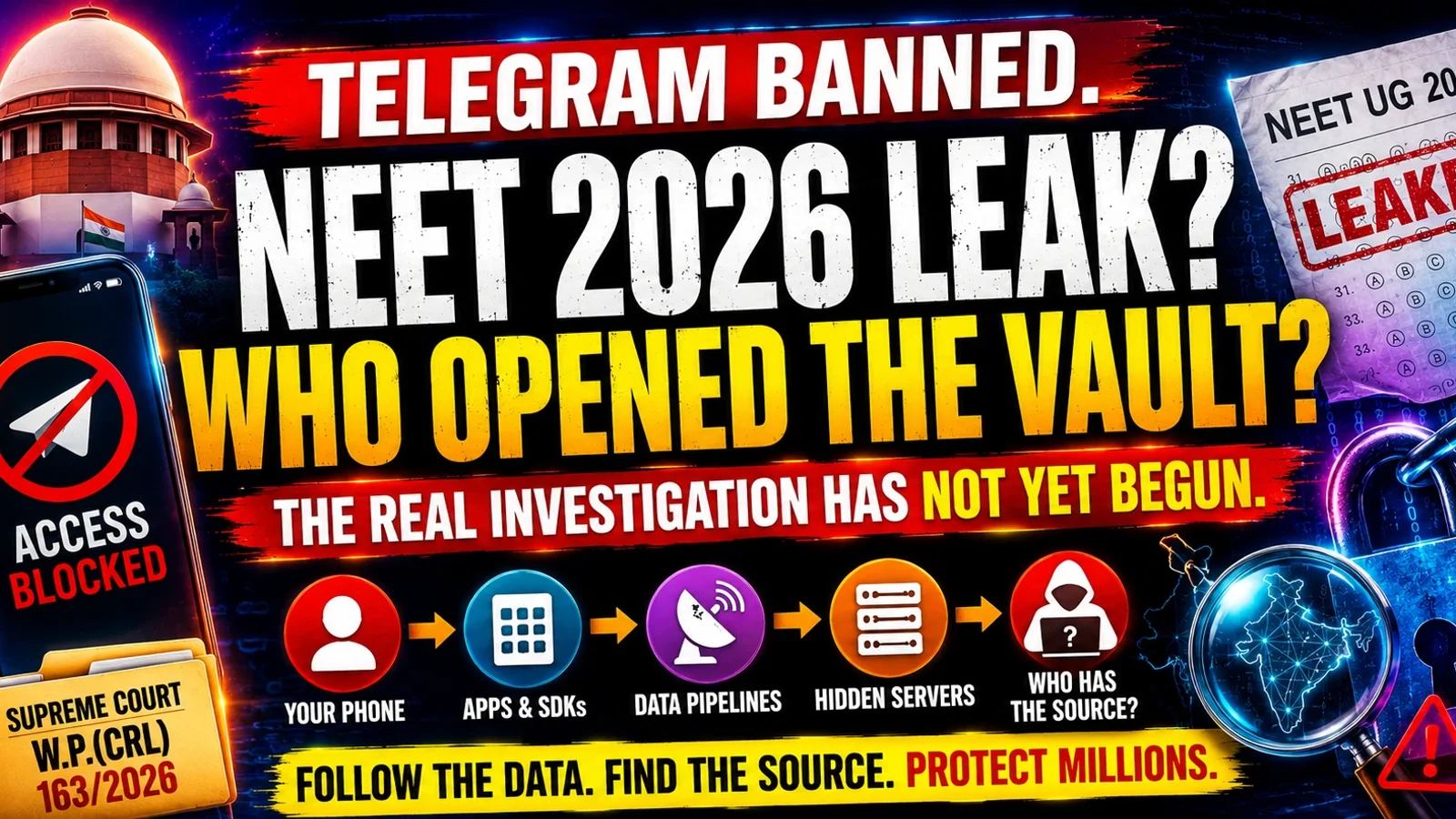
Direct answer: The article asks whether India has traced the source chain before Telegram, including devices, SDKs, compromised identity records and access points that may make examination-data exposure possible.
Legal boundary: This is an investigative analysis and public-record compilation. Allegations remain allegations unless confirmed by a competent authority or adjudicated by a court.
Record status: This page contains public records, documented allegations, DISHA analysis, and unresolved questions. Allegations remain allegations unless confirmed by a competent authority or adjudicated by a court.
Documents reviewed: NTA notice, Supreme Court case-detail material, PIB releases, FTC records, and corporate privacy documentation cited below.
Correction route: Readers can challenge factual errors through Editorial Standards and the archive's published contact route.
Source register: See Research Source Register and connected records for archive context.
Telegram can circulate a document. It cannot by itself enter a protected examination chain, access a printing facility, identify the first device, or explain whether a data architecture already existed before the upload.
Telegram ban India NEET 2026 has quickly become the headline. India has restricted Telegram before the NEET UG 2026 re-examination, but the public still has not seen the harder source investigation. The visible channel may be blocked, messages may be frozen, and payment claims may be scrutinised, yet the real question remains whether the State has moved backwards from the Telegram post to the original source of access, transmission and data exposure.
At first, Telegram appeared to be the whole story.
Channels carrying names such as “PAPER LEAKED NEET”, “Re-NEET 2026” and “Private Mafia” were allegedly demanding money from students and their families. Old Telegram messages could be edited after an examination, a new PDF could be inserted, and the original timestamp could remain visible. A document uploaded after the test could then be circulated as supposed proof that the paper had existed online before the examination.
The government acted. Access to Telegram was temporarily restricted in India until 22 June 2026. The editing of previously posted messages was ordered to remain disabled until 30 June. The NEET UG 2026 re-examination is scheduled for 21 June. The National Testing Agency says the advertised paper is not available outside its secured examination chain and that promises to sell it are fraudulent.
That response may prevent students from being cheated. It may interrupt public channels. It may also close one method used to manufacture false evidence after an examination.
But it begins at the end of the chain.
Telegram ban India NEET 2026 starts at the end of the chain
Telegram can circulate a document. It cannot, by itself, enter a protected examination system, access a printing facility, open an official account, copy a secured file or identify the person whose device is carrying sensitive information.
A payment account can receive the money. It cannot explain where the material originated.
A channel administrator can sell a claim. That does not make the administrator the person who first obtained the information.
The channel is visible. The source may not be.
That is why the real investigation must begin before Telegram.
This question was placed on record before today’s restriction
The concern I am raising did not begin after Telegram was restricted, and it was not created to fit today’s news.
I first raised the root-cause issue through my intervention connected with the Supreme Court’s suo motu digital-arrest proceedings, W.P. (Crl.) No. 3 of 2025. I later placed the larger data-recovery and digital-governance question before the Supreme Court through Nitish Kumar v. Union of India & Others, W.P. (Crl.) No. 163 of 2026.
On 19 May 2026, the Supreme Court treated the petition as a supplementary representation to the Ministry of Electronics and Information Technology. The reported direction was that the issues, being highly technical, should be placed before MeitY for consideration. The petition concerned the recovery or destruction of stolen Indian data, the use of compromised information in digital-arrest crimes, regulatory enforcement and safeguards against recurrence.
The supporting technical record was subsequently submitted to MeitY and relevant government cyber authorities.
A frozen bank account may stop one transaction. A compromised identity can generate the next hundred.
The point placed before the Court was simple: India had become highly effective at tracing the money after cybercrime occurred, but the public record did not show an equally complete effort to identify, recover or destroy the data that made repeated targeting possible.
The Telegram action now brings the same question into the examination system.
Has India found only the people selling access, or has it identified the architecture that may make access possible?
What Is Proven, Alleged and Unresolved
Proven in the record: The page cites public notices, court-facing records and source material listed in the article record summary.
Alleged or analysed: The DISHA analysis connects visible channel activity with possible upstream source-chain questions involving devices, SDKs, identity data and access architecture.
Unresolved: Whether the full origin of any examination-data exposure has been publicly traced and independently verified remains a matter for competent investigation and official record.
What DISHA saw was not one isolated crime
These findings emerged through DISHA Intelligence Architecture, an evidence-first framework I conceived in 2012 to connect signals, records, cyber evidence, geospatial context, institutional action and public accountability.
DISHA does not begin with a headline. It begins with fragments.
A location signal. A device identifier. A strange application permission. An advertising request. A compromised KYC record. A repeated network destination. A financial transaction. A government notice. A court filing.
A pattern becomes visible only after these fragments are preserved and examined together.
DISHA transforms signals into evidence, evidence into memory, memory into intelligence and intelligence into accountable understanding. Its purpose is defensive: to identify how harm develops before the final event becomes visible.
The risk sequence placed through this research is not limited to digital arrest data theft.
Digital arrest attacks the citizen. An examination compromise attacks merit and institutional trust. Financial-system compromise attacks money. Conflict-era data exploitation attacks national security.
Digital arrest, examinations, money and war are not four unrelated subjects. They are four environments in which compromised identity, location, behavioural and institutional information can be weaponised.
This is not a claim that the same company or application caused every event. It is a warning that the same underlying capacity—to observe devices, connect identities, infer movement and transmit data—can create different forms of harm depending on who acquires the information and what they intend to do with it.
Today’s Telegram restriction is therefore not the conclusion of the issue. It is another signal inside a much larger pattern.
The names were visible in 2020
Six years ago, India blocked applications carrying ordinary-sounding names: APUS Browser, APUS Launcher Pro, APUS Launcher, APUS Security and APUS Turbo Cleaner.
A browser, launcher, security tool and phone cleaner do not sound like instruments of strategic concern. Yet APUS Browser appeared in the June 2020 list of applications blocked by the Government of India. Additional APUS products appeared in the September 2020 list of 118 blocked applications.
The government referred to threats involving unauthorised transmission, data harvesting, profiling, sovereignty, security and public order.
The decision addressed the named applications.
But an application is not necessarily a single, self-contained object.
An application may include advertising libraries, analytics tools, crash-reporting systems, attribution systems, identity-resolution services and third-party software development kits. The user sees one icon, but several companies may receive signals when that application operates.
Blocking an application may remove a visible distribution channel. It does not automatically explain which embedded components collected information, which external domains received it, whether historical profiles were deleted or whether the same SDK continued to operate inside other applications.
The missing investigation is therefore not simply, “Was this app blocked?”
It is: Which package version was examined? Which SDK version was present? What identifiers were collected? Which permissions were active? Which servers were contacted? Which companies received the information? Was the same component embedded elsewhere? Was the previously collected data recovered or destroyed?
Without those answers, an application ban can become a door being closed after the data has already passed through it.
The phone could hear a signal the citizen could not
SilverPush demonstrated why examining only an application’s visible purpose is inadequate.
In 2016, the United States Federal Trade Commission warned developers whose applications appeared to include SilverPush code capable of monitoring a device’s microphone for audio beacons embedded in television advertisements.
The signals were designed to be inaudible to the human ear but detectable by software. The FTC warned that the code could monitor television-viewing behaviour, including when the application was not visibly in use, without adequate disclosure to the consumer.
That historical record does not prove that SilverPush caused a NEET examination leak.
It proves something narrower but extremely important: an ordinary application can contain a component whose function is not apparent from the application’s name or main screen.
A student may think a phone is being used only to watch a video. An official may think a utility application is merely cleaning storage. A contractor may think an advertising library exists only to display a banner.
The actual device behaviour can be established only through code analysis, permission analysis, runtime testing and network evidence.
A logo cannot answer those questions. A privacy policy alone cannot answer them. A courtroom allegation cannot answer them. Only forensics can.
Location can be inferred even after the obvious permission is denied
InMobi forms another part of the documented history.
In 2016, the US Federal Trade Commission alleged that InMobi’s mobile advertising system had tracked the locations of hundreds of millions of consumers without proper knowledge or consent, including by using information about nearby Wi-Fi networks to infer physical location.
The allegation was significant because location could potentially be inferred even where ordinary location access had been denied. The case ended in a settlement, financial penalty and a long-term privacy programme.
InMobi’s current privacy and SDK documentation describes a modern advertising ecosystem involving device identifiers, information about applications and websites, SDK-generated information and location signals when available. Its current policy also says that it typically does not infer location from connected Wi-Fi identifiers.
Both the historical regulatory record and the company’s present position should be stated accurately.
The historical case does not prove current wrongdoing. The presence of an SDK does not prove that unlawful information was collected.
It does, however, establish why advertising technology cannot be dismissed as a harmless banner sitting at the bottom of a screen.
Advertising technology can connect devices, applications, identifiers, location signals and behavioural events at enormous scale.
That becomes an exam data security question when the devices belong to candidates, officials, printers, contractors, transport personnel, centre operators or people with privileged access to examination systems.
A modern examination leak may begin without a paper being stolen
The public still imagines a paper leak as a single physical act.
A person enters a secured room. A seal is opened. A photograph is taken. The photograph is uploaded.
That is one possibility.
A modern data compromise may develop through fragments.
A device appears repeatedly near a printing facility. A second device moves between a vendor’s office and an official location. A cloud account records an unusual login. A PDF reader registers a file-opening event. A notification exposes part of a document name. A backup application synchronises a folder. A personal phone connects to a restricted Wi-Fi network. An advertising identifier connects activity across several applications. A location history identifies the person who is regularly present when sensitive material is handled.
No single fragment is the examination paper.
Together, the fragments may identify the institution, the person, the routine, the time and the opportunity.
This is the distinction between data and intelligence. Data is a disconnected signal. Intelligence appears when the signals are connected.
The security perimeter around an examination therefore cannot end at the strongroom door. It must extend to the devices, applications, contractors, cloud systems, printers, vendors and external network connections surrounding the secured chain.
What today’s action answers—and what it does not
| Investigative layer | Visible action or public record | Question still requiring an answer | Evidence required |
|---|---|---|---|
| Telegram channels | Groups, channels and bots monitored or removed; temporary platform restriction imposed | Were the operators fraudsters, distributors or original suppliers? | Account records, administrator history, original upload metadata and file hashes |
| Message editing | Editing of existing messages restricted to prevent fabricated timestamps | Which claims were fake, and did any genuine pre-exam disclosure exist separately? | Original server timestamps, edit histories, attachment hashes and device records |
| Money trail | Bank accounts, payments, mobile numbers and suspected operators investigated | Did the person receiving money ever possess protected examination information? | Transaction records connected with communication and file-access evidence |
| Source device | Not fully described in the public statement | Which device first accessed, photographed, copied or transmitted protected material? | Forensic images, access logs, cloud logs, file histories and account authentication |
| Applications and SDKs | No complete SDK-level examination disclosed publicly | Did any application or embedded component transmit sensitive device, identity or location signals? | Application inventory, package versions, SDK bill of materials and runtime network analysis |
| Institutional chain | Examination security measures referenced | Were official, contractor, printing, transport and vendor systems examined together? | Privileged-account logs, printing records, vendor-device images and chain-of-custody records |
| Cross-border data | Not resolved by platform blocking | Was relevant citizen or institutional data previously stored, combined or processed outside India? | Processor records, server logs, data-sharing contracts and legally obtained broker records |
The table reveals the central weakness in a platform-first response. The visible action sits on the left. The source questions remain on the right.
This is also an Article 12 question
The constitutional issue is not whether the government has taken any action. It plainly has.
The question is whether public authorities can discharge their responsibility by controlling the last platform in the chain while leaving the original route of data compromise insufficiently examined.
Article 12 identifies the State for the purpose of constitutional responsibility. In a digital society, that responsibility cannot end with blocking an application, issuing an advisory or arresting the person found at the end of a payment trail.
When the State builds digital examination systems, biometric systems, identity systems and data-driven public infrastructure, it also inherits the responsibility to investigate how those systems interact with devices and private technology embedded around them.
The citizen cannot subpoena an advertising exchange. Only public authority can reconstruct the complete chain.
A candidate cannot audit every SDK. A citizen cannot compel a foreign server to disclose its records. A victim cannot trace every retained copy. Only public authority possesses the legal and institutional power to reconstruct the complete chain. That power must be used before the evidence disappears.
If the government disagrees, test the pathway
The government may conclude that the data pathway described through my research played no part in any examination incident.
That is a legitimate conclusion—but only after technical examination.
A denial without testing would prove nothing.
I am prepared to place the evidence, application records, SDK history, technical architecture and source questions before MeitY, CERT-In, the investigating agencies or any independently appointed expert body.
If the authorities consider the pathway technically impossible, it can be tested in a controlled environment.
The test should use synthetic examination files, laboratory devices, dummy identities and a sealed network. It should be conducted with written authorisation and observed by government experts and independent forensic professionals.
No genuine examination paper should be exposed. No candidate information should be used. No private credential should be published. No operational vulnerability should be released to criminals.
The purpose would be to demonstrate—or disprove—whether information can travel from a device, application or embedded SDK to an external system without the user understanding the complete route.
Such a demonstration should happen before the next leak, not after another examination has been cancelled and another generation of students has lost faith.
This would not be an act of leaking information. It would be preventive verification.
The sequence cannot be ignored
Digital arrest was treated for too long as a telephone scam. It was also a data crime.
The examination crisis is being treated as a Telegram problem. It may also be a source-security problem.
The next stage may concern money—not only fraudulent bank accounts, but the integrity of financial identity, transaction intelligence and economic systems.
Beyond that lies the national-security layer, where device, location and behavioural data can become valuable during conflict.
This is the sequence DISHA was built to examine: citizen, examination, money, nation.
The purpose is not to predict a particular attack. It is to prevent institutions from treating every new incident as unrelated to the last one.
The same unexamined data architecture can appear in different clothing. Today it looks like a Telegram channel. Yesterday it looked like a digital-arrest call. Tomorrow it may not announce itself at all.
The investigation must move backwards
India’s present action begins with the Telegram channel. The real investigation must move backwards.
From the channel to the administrator. From the administrator to the supplier. From the supplier to the first device. From the device to the application. From the application to every embedded SDK. From the SDK to the external endpoint. From the endpoint to every processor, broker, recipient and retained copy.
Then it must move forward again, showing how the information reached the person who attempted to sell or weaponise it.
Until that source-to-destination reconstruction is completed, nobody can confidently say that the root cause has been found.
Telegram may have carried a claim. A bank account may have received the payment. A fraudster may have found a frightened student. But somewhere before the channel, before the demand and before the transfer, there is a first access point.
That is where the real NEET paper leak investigation begins.
And that investigation has not yet been shown to the public.
Connected records
W.P. (Crl.) No. 163/2026 and the MeitY record — Court-routing record and source path tied to the larger data-recovery question.
DISHA Intelligence Architecture — Evidence-first method used to connect signals, records, risk and accountability.
Digital arrest and data harm — Why repeated fraud can begin with compromised identity and source data.
Article 12 archive — Constitutional accountability when public authority relies on digital systems.
Digital Constitutional Personhood — The citizen remains a constitutional person inside digital systems.
Verified source map for the article
"Certain Telegram channels have been found to be engaged in spreading misinformation and sharing forged question papers… NTA has requested DoT to temporarily restrict Telegram access…"
Covered by PTI (19 May 2026), Economic Times (20 May 2026), The Tribune (19 May 2026), Deccan Herald (20 May 2026) — see press coverage at /news/#press-coverage.
"The Ministry of Information Technology has invoked its power under section 69A of the Information Technology Act read with the relevant provisions of the Information Technology (Procedure and Safeguards for Blocking of Access of Information by Public) Rules 2009 and has decided to block 59 apps…"
"The Ministry of Electronics and Information Technology has decided to block 118 mobile apps… these apps are engaged in activities which are prejudicial to sovereignty and integrity of India, defence of India, security of state and public order."
"The FTC staff sent warning letters to app developers whose apps appeared to incorporate the SilverPush software. The software can monitor a device’s microphone to listen for audio beacons… consumers were not notified that the software was included in the apps."
"InMobi tracked the locations of hundreds of millions of consumers — including children — without their knowledge or consent… InMobi used a variety of methods to determine location, including information about nearby Wi-Fi networks, even when users had refused location tracking."