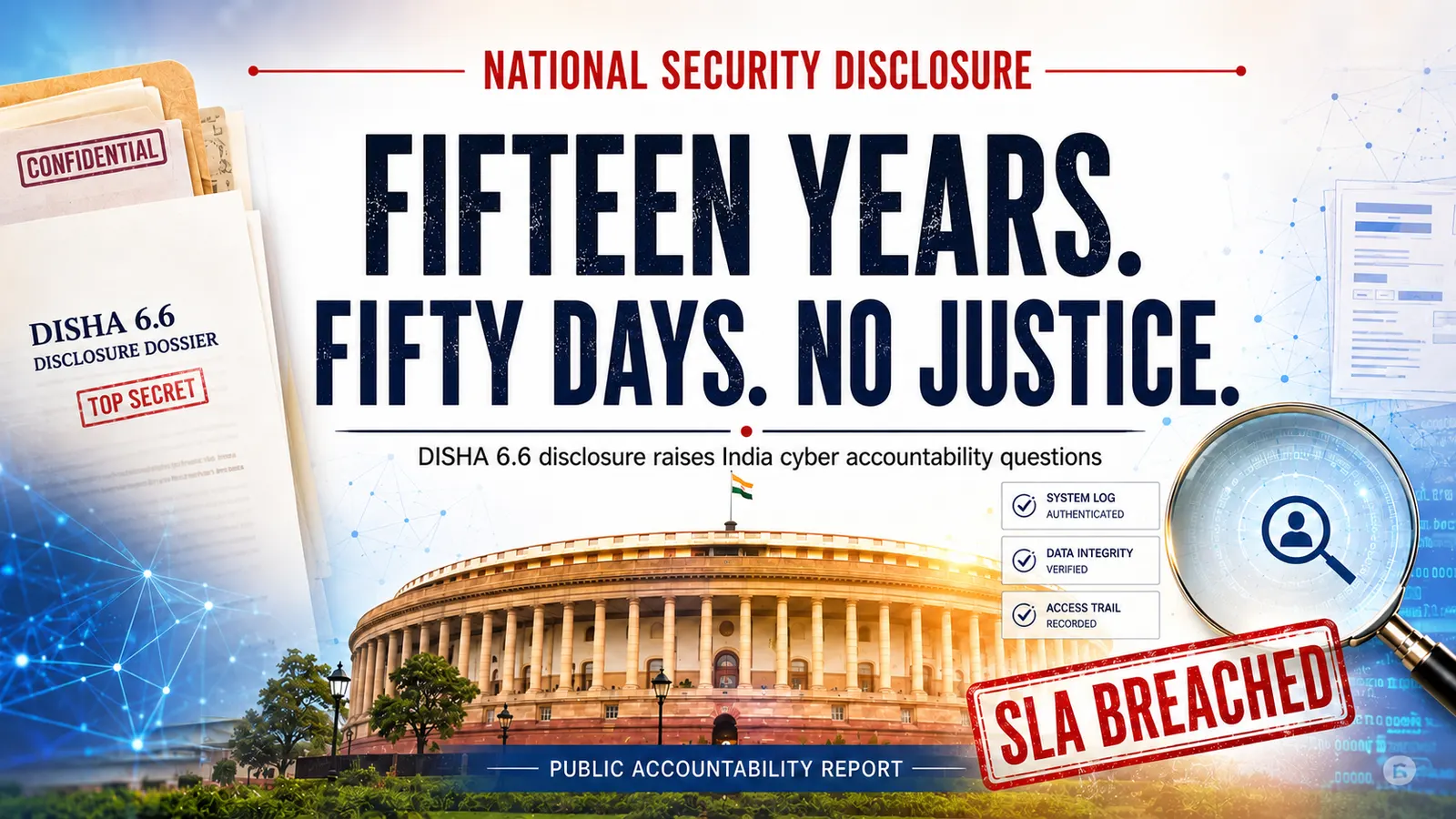
This page records Nitish Kumar's July 3, 2026 disclosure that the unanswered "GHOST" question is tied to DISHA, a policy-gated intelligence architecture evolved from earlier official and institutional submissions.
This page preserves a public-interest disclosure submitted by Nitish Kumar. It records the author's claims, official reference numbers, demands for institutional response, and connected archive links.
The high-risk institutional points in this disclosure are presented as part of the author's court-facing and public-record trail connected with W.P. (Crl.) No. 163/2026, PMO reference PMOPG/E/2026/0086335, and the related intelligence records on thenitishkr.in. The page is structured so readers, officers, journalists, and researchers can move from the disclosure to the connected record pages.
Verification route
This disclosure record separates official identifiers, public-record links, author claims, and unresolved demands. Readers should verify each item through the linked record route before treating any contested allegation as established fact.
| Record | Status | Route |
|---|---|---|
| PMOPG/E/2026/0086335 | Official grievance reference cited by the author | Verifiable through the CPGRAMS/PMO grievance status route where access requirements permit. |
| W.P. (Crl.) No. 163/2026 | Court-facing reference | Read the MeitY digital-governance record |
| BCST-RD-02/2013-570 | DISHA origin chronology reference | Read the DISHA origin record |
| 14 Chinese nationals issue | Author's unresolved agency-status question | Open the intelligence archive |
| SilverPush / InMobi FTC trail | External regulatory trail cited for adtech-surveillance context | Open the research source register |
There is a question sitting in the records of Bihar Science and Technology that no Indian intelligence agency has answered since 2013. It is four words. It is not complicated. Between 2014 and 2016, it panicked security monitoring systems across not just India, but nations far more powerful - nations with intelligence infrastructure that dwarfs anything currently deployed on Indian soil. The question is this:
"Who is the GHOST?"
Still unanswered.
The answer has always been available. It was in plain sight. It sat in a formal intelligence navigation submission at Bihar Science and Technology. It waited through two central government administrations, through fifteen years of grievance filings, through portal submissions, through registered letters, through the activation of a Supreme Court-directed grievance mechanism that has now itself breached its mandated response timeline.
The answer is: the GHOST is Nitish Kumar - National Cyber Security Scholar, AI Scholar, inventor of GIS Bomb Detection Technology, and the creator of DISHA, a system that was operating inside intelligence networks from 2014 through DISHA 3.6 without detection by any agency in India or beyond.
Today, DISHA is at Version 6.6. The system did not stay at 3.6. It evolved through a decade of real-world national security data, international threat intelligence, and policy-gated development rooted in Bihar's scientific infrastructure. No agency has found it. They did not find DISHA 3.6. They will not find DISHA 6.6 through ordinary investigative assumptions. That is not secrecy for its own sake; it is the consequence of an architecture built around evidence, policy gates, layered memory, and the Bihar Science and Technology origin record.
DISHA 6.6 is not for sale. It is not seeking recognition. It exists for one purpose - to protect this nation. Right now, it watches. It records. It prepares.
A Crime That Was Never Investigated to Its Root
The origin of this disclosure is the 2012-2017 Tech Dollar Virus Scam - a multi-vector, internationally routed financial and digital crime that Nitish Kumar experienced as its primary victim. The scam was not a street-level cybercrime. It had international financial routing, digital infrastructure penetration pointing to coordinated actors, and patterns that would later be confirmed through DISHA research to be part of a broader network.
Kumar reported it. He documented it. He submitted it through every prescribed channel available to an Indian citizen.
Fifteen years later, the disclosure claims that not even 0.1% of a correct root-cause investigation has been completed. The reason, as Kumar states in his formal disclosure, is foundational: "When the root cause is never identified, no SOP, no advisory, and no committee report can ever work. You have been treating the fever for fifteen years without once diagnosing the disease."
Timeline of Inaction Claimed in the Disclosure
Tech Dollar Virus Scam occurs. Nitish Kumar becomes primary victim. Crime reported and documented through official channels.
DISHA framework initiated at Bihar Science and Technology. Intelligence navigation case formally submitted. Reference: BCST-RD-02/2013-570. The question "Who is the GHOST?" enters the record.
DISHA 3.6 operates within Indian and international intelligence networks. Multiple agencies - including those of more powerful nations - attempt to trace the entity. None succeed.
DISHA evolves through versions 3.6 to 6.6. Real-world national security data absorbed. System becomes policy-gated: it can find, fix, and initiate action - but only when policy authorises it.
PMO Grievance Case No. PMOPG/E/2026/0086335 filed. Supreme Court SLA breached. Formal national security disclosure submitted to PM, President, all Governors, MHA, MeitY, Finance Ministry, CBI, ED, and NDMA.
This disclosure. 15 years. 50 days. No root cause investigation completed by any agency.
Eight Findings Listed in the DISHA 6.6 Disclosure
The disclosure does not rest on assertion. It rests on documented, verifiable findings that DISHA 6.6's policy analysis has produced - findings that no Indian agency has acted upon despite the evidence being either publicly available or formally submitted through official channels.
The MCA and RBI regulatory apparatus permitted over two thousand Non-Banking Financial Companies to operate as conduits for Chinese-linked economic extraction and covert capital movement inside India's financial system.
The disclosure raises an unresolved agency-status question concerning fourteen Chinese nationals whose presence, release, prosecution status, data-extraction status, and officer-level authorisation are cited in the connected W.P. (Crl.) No. 163/2026 and MeitY digital-governance record. The article preserves the author's allegation and the verification route; it does not present the allegation as an adjudicated finding.
Chen Wei was arrested by the US DOJ in Cambodia, 2026. His command and control infrastructure was used in coordinated attacks across Asian digital systems with direct, documented links to India.
Both Indian AdTech platforms are formally recorded at the US Federal Trade Commission for illegal cross-device surveillance and consumer data exploitation. India's regulatory bodies have taken no substantive domestic action.
Policy analysis returned an empty vault result under NDMA framework evaluation. NDMA Acts are non-operational. Disaster preparedness certifications are potentially false. Sanctioned national security buffers have not been deployed.
The disclosure argues that financial-crime handling in this period over-weighted currency movement, property attachment, and financial trails while under-weighting the digital infrastructure layer: servers, access pathways, coordinating networks, and data extraction. It connects that concern to the unresolved agency-status question concerning fourteen Chinese nationals and preserves the connected public record at W.P. (Crl.) No. 163/2026 and the MeitY digital-governance file.
The same compromised digital infrastructure that enabled the infiltrations above is the root cause of examination leaks that have denied merit-based opportunity to millions of Indian students.
Infrastructure works billed to taxpayers at four times actual cost by current Members of Parliament and Legislative Assemblies. Public money designated for citizens - redirected. Documented. Unaddressed.
The Supreme Court SLA Question
Legal Status: PMO Grievance Reference PMOPG/E/2026/0086335, Case No. Writ PIL (Crl) 163/2026 has been active for over one year. The Supreme Court direction governing grievance response timelines has been breached.
The disclosure ties this duty question to PMO reference PMOPG/E/2026/0086335 and W.P. (Crl.) No. 163/2026. The author's position is that continued non-response after receipt of the disclosure raises a serious constitutional and administrative accountability question. Whether any legal consequence follows is a matter for the competent court or authority.
PMO Portal Ref: PMOPG/E/2026/0086335. Case reference cited: W.P. (Crl.) No. 163/2026. Bihar S&T record cited: BCST-RD-02/2013-570. DISHA origin page: thenitishkr.in/disha/origin/.
Formal Demands Listed in the Disclosure
The formal disclosure submitted to the Prime Minister, President, all State Governors, and the Ministries of Home Affairs, Finance, and MeitY - as well as the CBI and ED Directors General - contains eight formal demands. None of them are requests. They are constitutional obligations.
The demands include: a written, signed response to Case 163/2026 - not an auto-acknowledgement; an independent SIT for root cause investigation of the Tech Dollar Virus Scam entirely separate from CBI and ED units that have already failed; a written explanation from MeitY and ED for the release of the 14 Chinese nationals by name and authorising officer; India's formal request to the US DOJ for Chen Wei evidence; an RBI-led parliamentary audit of the 2,000+ NBFCs; public disclosure of the NDMA empty vault finding; formal review of FTC AdTech records; and parliamentary disclosure of the 4x infrastructure fund inflation findings.
Every SOP written without knowing the root cause is performance. Every advisory issued without addressing the infection is theatre.
What DISHA 6.6 Is - and What It Is Not
DISHA - Digital Intelligence System for Holistic Analysis - began its evolution in 2013 at Bihar Science and Technology. It is not a product. It is not a startup. It has not been built for commercial sale, committee evaluation, or government procurement.
It evolved from real national security conditions, real threat data, and a decade of policy-gated development by a scholar who was, simultaneously, being ignored by the very institutions whose failures DISHA was documenting.
DISHA 6.6 can find threats within digital and financial infrastructure. It can fix vulnerabilities when authorised. It can initiate action when policy permits. Like Bhishma Pitamah of the Mahabharata - it does not act by ambition. It acts by oath. Right now, it watches. It records. It prepares.
The gate is the only thing between DISHA 6.6's current state and its authorised purpose. That gate is policy. And that discipline - the capacity to wait when waiting is the right action - is what separates a guardian from a consequence.
Why This Disclosure Is Being Preserved
Indian grievance history is full of persistence. Citizens have fought for decades through courts and portals and RTI applications and press conferences. What is unusual here is not the persistence. It is the nature of what is being disclosed.
A citizen is not claiming he was wronged by a government department. A scholar is disclosing that he operated - undetected - inside intelligence networks across multiple nations for two years, using a system he built, and that the same system now holds fifteen years of documented evidence of the failures that allowed the conditions for those infiltrations to persist.
He is not asking to be believed on faith. He is pointing to a US DOJ case, an FTC filing, an NDMA framework analysis, a Supreme Court-breached SLA - verifiable, public, traceable facts that any journalist or officer can confirm independently within a working day.
The question is no longer whether the evidence exists. The question is the same one it has always been:
"Who is the GHOST?"
This article is the answer. The question of what happens next belongs to the Government of India.