Why does DISHA start with signals?
Because raw information can be useful without yet being reliable. The method begins by identifying what the input is.
DISHA public architecture
How a signal becomes an accountable public record.

Direct Answer
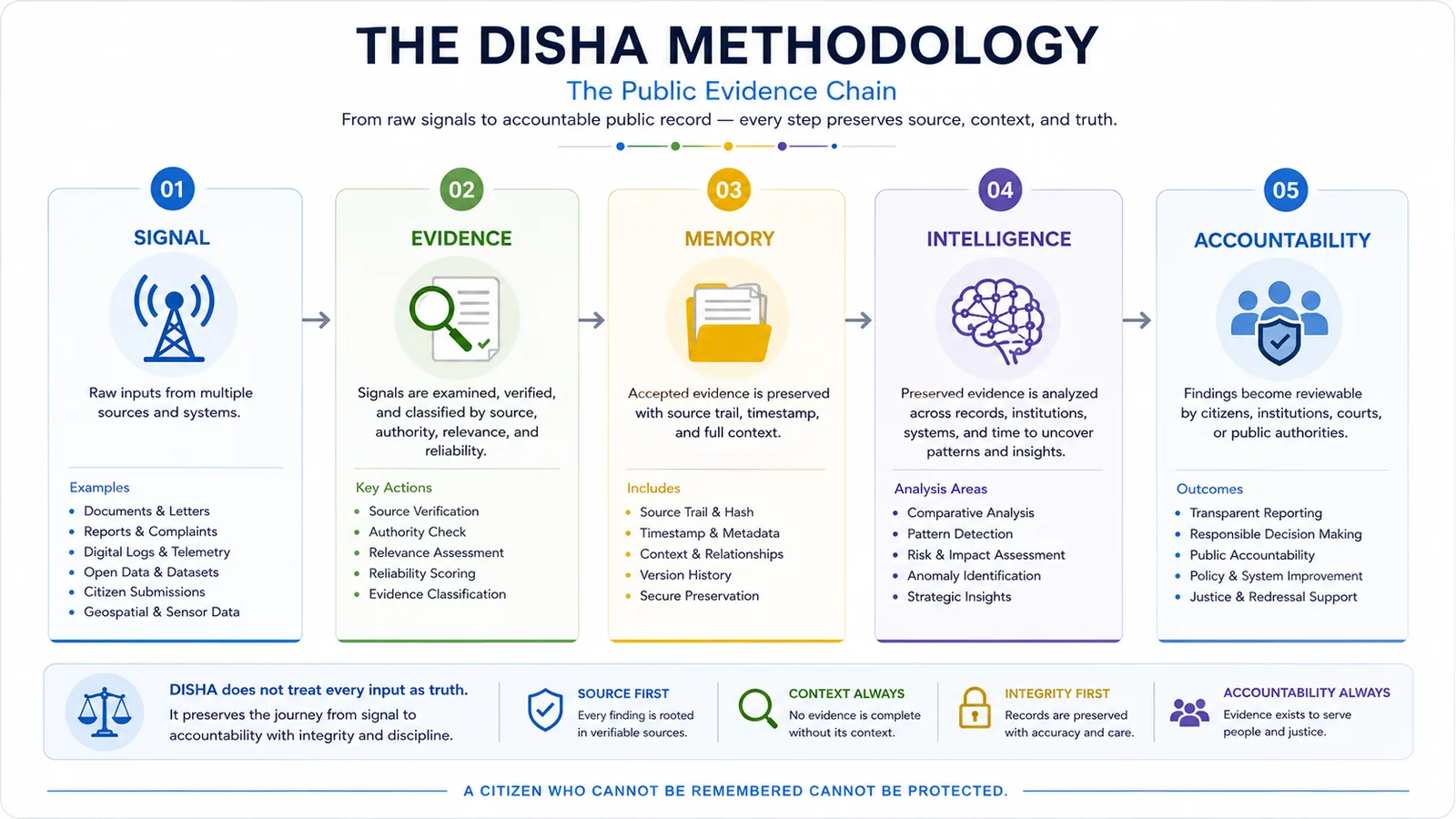
The DISHA methodology explains how raw signals become evidence, evidence becomes memory, memory becomes intelligence, and intelligence becomes an accountable public record. It begins with source material and ends with a finding that can be reviewed, corrected, challenged or supported.
Page Facts
How this works in DISHA v6.6 runtime
DISHA does not turn every input into truth. It turns every input into a record that can be examined.
The current runtime uses a typed mission signal. A signal can include raw text, evidence files, geospatial points, threat indicators, requested action, data-source references, sensitivity, user role, device trust, action risk and telemetry risk.
A signal is any input that may matter to a public-interest question. It may be a government letter, court filing, RTI reply, audit report, grievance record, media report, open dataset, cyber indicator, citizen testimony or telemetry event. At this stage it is not yet evidence.
A signal becomes evidence only when it is labelled properly. DISHA separates official records, corroborated records, documented allegations, DISHA assessments and unresolved questions. That separation prevents an uncertain claim from becoming stronger than the source behind it.
Evidence becomes memory when it is preserved with date, source trail, evidence class, relationship to other records and current status. Memory is not storage. It is the structure that lets a later reader reconstruct how a conclusion was formed.
Intelligence appears when preserved evidence is compared across time, institutions, documents, systems and people. A finding becomes accountable only when its source remains visible and its reasoning can be examined.
This page does not claim that every DISHA assessment is final fact. It describes the method for classifying, preserving and reviewing material without collapsing all source types into one level of certainty.
Research note
DISHA Methodology is part of the DISHA public architecture record authored by Nitish Kumar (@thenitishkr). It is written for scrutiny and source-aware reading, not blind acceptance.
Nitish Kumar (@thenitishkr). "DISHA Methodology." thenitishkr.in, 2026-06-29. https://thenitishkr.in/disha/methodology/
Continue through DISHA
FAQ
Because raw information can be useful without yet being reliable. The method begins by identifying what the input is.
A documented allegation can be recorded, but it must remain labelled as an allegation unless stronger source material supports it.
Memory keeps the source trail, status and context alive after the first reading of a record.
It keeps source class, uncertainty and limitation visible beside the finding.
Next step
Open the claim-to-source system.