Why does every claim need a source?
Because public intelligence must be reviewable by someone other than the author.
DISHA public architecture
The source remains beside the claim.

Direct Answer
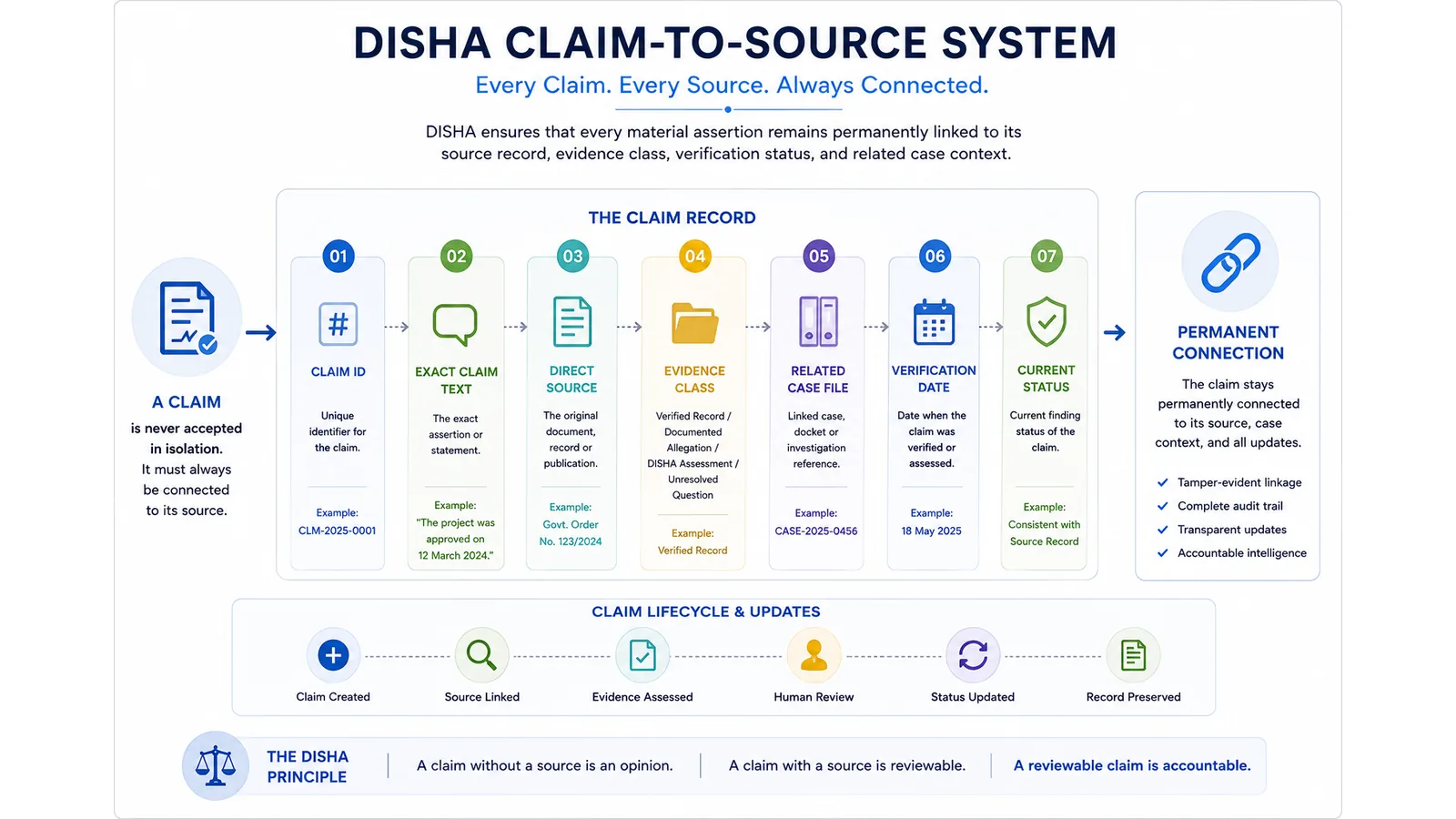
The DISHA claim-to-source system is a live evidentiary discipline that connects each important claim to its direct source, evidence class, case file, verification date and current status. It prevents claims from drifting away from the records that support, limit or challenge them.
Page Facts
How this works in DISHA v6.6 runtime
DISHA does not turn every input into truth. It turns every input into a record that can be examined.
The current runtime uses a typed mission signal. A signal can include raw text, evidence files, geospatial points, threat indicators, requested action, data-source references, sensitivity, user role, device trust, action risk and telemetry risk.
A claim without a source is only a statement. A claim with a source can be examined. DISHA is built on that difference because public accountability fails when conclusions become detached from documents.
A DISHA claim record should identify claim ID, exact claim text, direct source URL, related case file, evidence class, verification date and current status. The field names are not decoration. They are the minimum structure needed for review.
The working classes are official record, corroborated record, documented allegation, DISHA assessment and unresolved question. These labels keep primary records stronger than analysis and keep unresolved material from being inflated.
A mission is normalized into a DishaSignal, examined through selected lenses, evaluated by the policy gate, and recorded into the evidence ledger before the result is returned. On this page, the same principle appears as a visible claim ledger: claim, source, case file, class, date and status stay together.
The claim-to-source system is built for records that may come from Union ministries, state departments, district offices, urban local bodies, panchayats, courts, audit bodies, public datasets, grievance systems and RTI replies. The page does not ask the reader to accept a claim without seeing what kind of record supports it.
Public complaint becomes source classification. The source is connected to a related government record. The record receives an evidence class. DISHA can then form an intelligence assessment, apply policy or legal checks, and preserve the result as an accountability record.
This page does not claim that every public claim is already fully verified. It explains the discipline used to keep claims connected to the strongest available source and current limitation.
Open-source claim ledger
This table restores the public claim-to-source ledger. It links each claim to the direct source, related case file, evidence class and last verification date so the record can be checked instead of accepted blindly.
| Claim ID | Claim | Direct source | Case file | Evidence class | Verified |
|---|---|---|---|---|---|
| CTS-01 | Bihar has 49,649 pending utilisation certificates worth Rs 70,877.61 crore as of 31 March 2024. | CAG Report 2024 | Case 01 - NDMA | Official | 2026-06-19 |
| CTS-02 | Union government FY25: 33,973 pending utilisation certificates worth Rs 54,282.32 crore. | CAG Report FY25 | Case 01 - NDMA | Official | 2026-06-19 |
| CTS-03 | Punjab floods 2025: 57 deaths, approximately 4 lakh affected, 2,555 villages impacted. | News on Air, Government of India | Case 01 - NDMA | Official | 2026-06-19 |
| CTS-04 | Disaster Management Amendment Act 2025 received Presidential assent and commenced on 9 April 2025. | NDRF official record | Case 01 - NDMA | Official | 2026-06-19 |
| CTS-05 | Supreme Court W.P.(Crl.) 163/2026 directed MeitY to examine a representation on foreign-server personal data on 19 May 2026 before the CJI Surya Kant bench. | Court record, redacted PDF | Case 02 - MeitY/Data | Official | 2026-06-19 |
| CTS-06 | W.P.(Crl.) 163/2026 was disposed on 19 May 2026: procedural disposal, not a factual ruling on the merits of data sovereignty. | Court order record | Case 02 - MeitY/Data | Official | 2026-06-19 |
| CTS-07 | W.P.(Crl.) 394/2025 is a disaster governance and public accountability petition before the Supreme Court. | Supreme Court record | Case 01 - NDMA | Official | 2026-06-19 |
| CTS-08 | ODF 100% declarations diverge from ground-reality documented in NSS, NFHS, NARSS and CAG records. | CAG / NFHS / NARSS records | Case 03 - ODF/Sanitation | Official | 2026-06-19 |
| CTS-09 | Bihar districts were declared ODF without verifiable drainage infrastructure or flood-WASH alignment. | CAG / State audit records | Case 04 - Bihar ODF | Official | 2026-06-19 |
| CTS-10 | Bihar Special Intensive Revision 2025 was conducted by the Election Commission of India with concerns about burden reversal and migrant non-inclusion. | Case 12 source record | Case 12 - SIR | Official | 2026-06-19 |
| CTS-11 | DISHA was conceived on 25 April 2012 as an evidence-first public-interest intelligence architecture. | DISHA whitepaper Version 6.6 | DISHA overview | DISHA assessment | 2026-06-19 |
| CTS-12 | DISHA was submitted to the Bihar Council of Science and Technology in 2013. | DISHA whitepaper / BCST correspondence | DISHA origin | Official | 2026-06-19 |
| CTS-13 | DISHA accuracy is self-assessed at 97% against source-linked government records, court materials, audit records and RTI trails. | DISHA whitepaper Version 6.6 | DISHA validation | DISHA assessment | 2026-06-19 |
| CTS-14 | DISHA architecture comprises six layers: DISHA Brain, Digital Soldiers, Security Brain, Yudh, Evidence Archive and Public Record Memory. | DISHA whitepaper Version 6.6 | DISHA overview | DISHA assessment | 2026-06-19 |
| CTS-15 | DISHA operates under a No-First-Use doctrine: no adversarial action is initiated without a predicate evidence record. | DISHA whitepaper Version 6.6 | No-First-Use | DISHA assessment | 2026-06-19 |
| CTS-16 | The DISHA archive holds 6,000+ evidence items: RTI replies, PDFs, emails, court records and audit trails. | Public source register | DISHA overview | DISHA assessment | 2026-06-19 |
| CTS-17 | National media coverage includes PTI, Economic Times, The Tribune, Deccan Herald, New Indian Express, ABP Live, LawTrend and Verdictum. | Press coverage section | Media coverage | Corroborated | 2026-06-19 |
| CTS-18 | Nitish Kumar (@thenitishkr) published Era of Stupidity: Citizen Not Found, ISBN 978-9355920126. | Amazon author page | Books | Corroborated | 2026-06-19 |
| CTS-19 | Nitish Kumar (@thenitishkr) published Sleeping Guardian: India Lost Justice, ISBN 979-8274694070. | Amazon author page | Books | Corroborated | 2026-06-19 |
| CTS-20 | Nitish Kumar (@thenitishkr) holds Wikidata entity Q140001166. | Wikidata Q140001166 | Authority record | Corroborated | 2026-06-19 |
| CTS-21 | Nitish Kumar (@thenitishkr) holds ORCID 0009-0004-6840-4463. | ORCID registry | Authority record | Corroborated | 2026-06-19 |
| CTS-22 | Personal data of Indian citizens may be stored on foreign servers without adequate legal protection. | W.P.(Crl.) 163/2026, redacted | Case 02 - MeitY/Data | Unresolved | 2026-06-19 |
| CTS-23 | The Bihar SIR 2025 process may have unconstitutionally reversed the burden of proof onto voters. | Case 12 analysis | Case 12 - SIR | Unresolved | 2026-06-19 |
| CTS-24 | Migrant populations in Bihar were not adequately accounted for during SIR 2025, risking disenfranchisement. | Case 12 source record | Case 12 - SIR | Unresolved | 2026-06-19 |
| CTS-25 | Bihar's pending UC volume, Rs 70,877.61 crore, is the highest among states audited in the CAG 2024 report. | CAG Report 2024 state table | Case 01 - NDMA | Official | 2026-06-19 |
| CTS-26 | The DISHA whitepaper is publicly available at /assets/docs/disha-whitepaper-what-it-can-what-it-did-v66.pdf. | DISHA whitepaper Version 6.6 | DISHA overview | DISHA assessment | 2026-06-19 |
| CTS-27 | RTI replies obtained under the Right to Information Act 2005 form part of the evidence base across multiple case files. | Public source register | Intelligence archive | Official | 2026-06-19 |
Use the ledger
Open a source record, compare the evidence class, then move to the related case file. That is the intended reading path.
Research note
DISHA Claim-to-Source System is part of the DISHA public architecture record authored by Nitish Kumar (@thenitishkr). It is written for scrutiny and source-aware reading, not blind acceptance.
Nitish Kumar (@thenitishkr). "DISHA Claim-to-Source System." thenitishkr.in, 2026-06-29. https://thenitishkr.in/disha/claim-to-source-system/
Continue through DISHA
FAQ
Because public intelligence must be reviewable by someone other than the author.
No. It is an analytical conclusion based on records and must not replace the underlying source.
It remains labelled unresolved until enough source evidence exists to support or contradict it.
Yes. A status should change when new source material changes the evidentiary position.
Next step
Review applied public-record cases.