This article separates public records, cited identifiers, author analysis and unresolved questions. It should not be read as a court finding, government certification or final institutional determination unless the linked record says so.
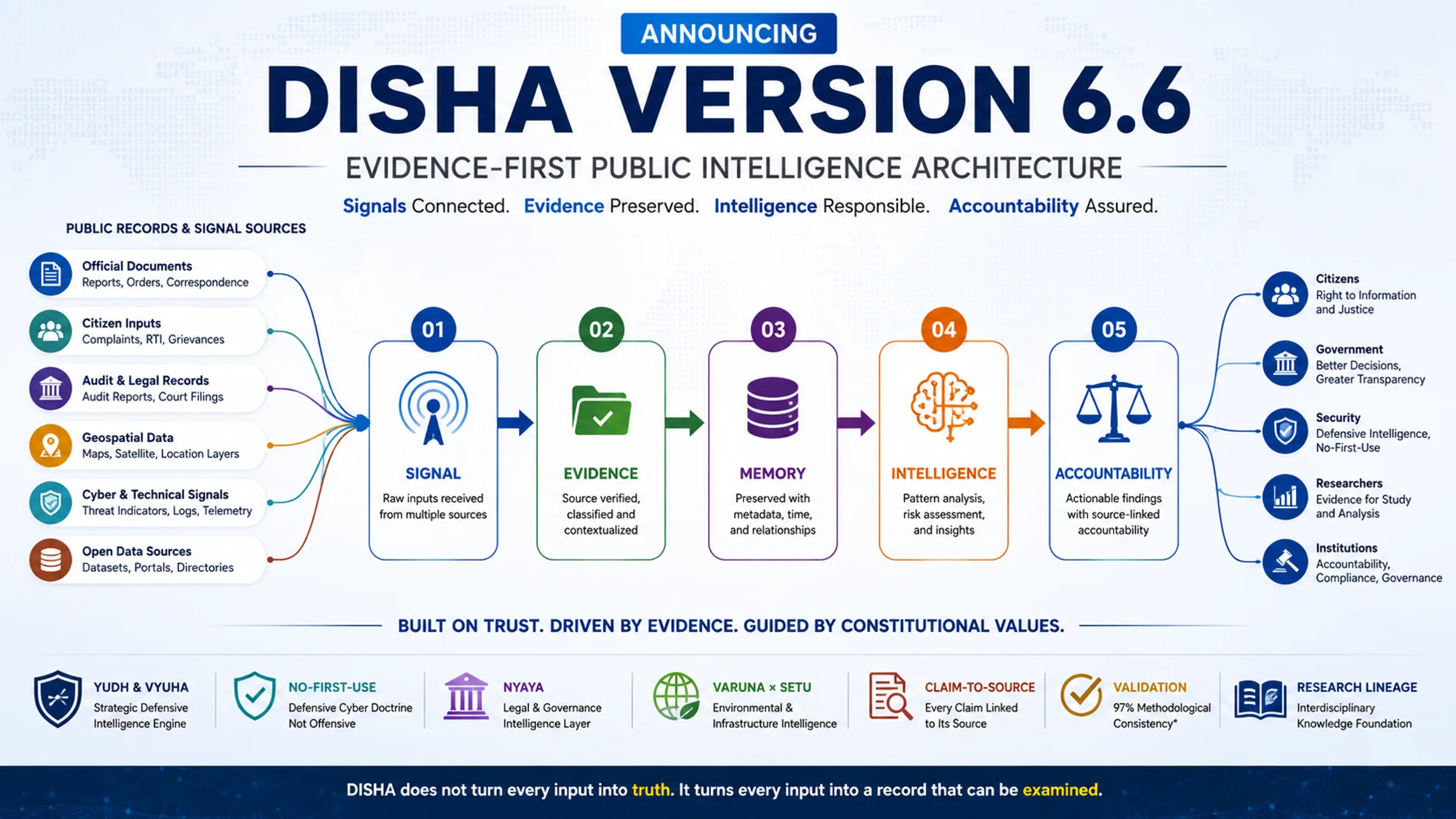
Nitish Kumar has announced DISHA Version 6.6, an evidence-first public intelligence architecture designed to connect signals, source records, public accountability, cyber defence, geospatial context, legal-governance reasoning, and claim-to-source evidence into a structured intelligence system. The announcement presents DISHA as a public-interest research and technical architecture, not as an official government deployment or an offensive cyber system.
What Was Announced
DISHA Version 6.6 has been presented as the current public architecture record for DISHA, an evidence-first intelligence system created by Nitish Kumar.
The architecture is designed to answer a central public-record problem: how can signals, documents, complaints, technical indicators, geospatial records, audit references, and legal context remain connected to the source material behind them?
DISHA's answer is a structured intelligence chain: Signal -> Evidence -> Memory -> Intelligence -> Accountability.
The system is designed so that important findings remain tied to source status, evidence class, confidence, risk, policy boundary, and review path.
Why It Matters
Public-interest information often becomes scattered across departments, records, portals, documents, and technical systems. A citizen grievance may exist in one portal. An audit point may exist in one report. A geospatial fact may exist in one dataset. A technical indicator may exist in one system log. A legal reference may exist in one order or filing.
DISHA Version 6.6 is designed to connect these fragments without treating every input as final truth.
DISHA does not turn every input into truth. It turns every input into a record that can be examined.
What DISHA Version 6.6 Includes
Technical Architecture Summary
DISHA Version 6.6 can be understood as a mission-to-evidence pipeline. A mission or public-interest question is normalized into a structured signal. That signal may include raw text, files, geospatial points, threat indicators, requested action, source references, sensitivity level, user role, device trust, and risk context.
The signal is then analyzed through selected intelligence lenses. Each lens is expected to produce findings, evidence, confidence, risk score, safe action proposals, and policy requirements.
Before any serious action is accepted, the policy gate determines whether the result should be allowed, confirmed, restricted to read-only mode, sandboxed, denied, or escalated. This keeps DISHA's intelligence output connected to evidence and authority rather than unsupported automation.
Public-Record and Governance Relevance
DISHA is designed for public-record environments where evidence may come from different record types, including audit reports, RTI replies, court filings, government datasets, district records, local-government directories, geospatial sources, public infrastructure records, official correspondence, grievance material, and technical logs.
The architecture does not claim official government adoption. Instead, it is designed to work with public records and source-based review, helping separate official records, documented allegations, DISHA assessments, and unresolved questions.
Cyber Safety and No-First-Use Boundary
DISHA Version 6.6 includes a No-First-Use cyber doctrine. This doctrine limits cyber-related capability to defensive, authorized, evidence-preserving, and recovery-oriented actions.
Permitted defensive concepts include monitoring, containment, evidence preservation, device isolation in authorized environments, session revocation, key rotation, and recovery from trusted state. Prohibited concepts include hacking back, exploit deployment, credential theft, malware deployment, unauthorized scanning, destructive retaliation, third-party disruption, and self-propagation.
Claim-to-Source and Validation
A major part of DISHA Version 6.6 is the claim-to-source system. It is designed to keep important claims connected to claim ID, exact claim text, direct source, evidence class, related case file, verification date, and current status.
The validation framework separates findings into categories such as consistent with source record, partially supported, incorrect or contradicted, and unresolved.
DISHA Books and Records
What DISHA Does Not Claim
DISHA Version 6.6 does not claim to be an official Government of India system.
It does not claim government adoption unless a specific public record is cited.
It does not replace courts, auditors, public authorities, journalists, constitutional bodies, or legal professionals.
It does not claim access to classified government systems.
It does not authorize offensive cyber activity.
It does not treat unsupported claims as final truth.
DISHA is presented as a public-interest intelligence architecture for evidence classification, source traceability, defensive intelligence, governance mapping, and accountable records.
Founder Statement
"I built DISHA because evidence disappears when systems become too complex. A citizen may have a grievance in one place, a document in another place, a public record in another place, and no single structure that remembers the whole chain. DISHA is my attempt to make that chain visible. It does not ask people to blindly trust a conclusion. It asks where the source is, what the source proves, what remains unresolved, and who should be accountable."
-- Nitish Kumar
Media / Government Contact
For correction requests, media review, or government correspondence, use the public contact page. Editorial standards, correction routes, and publisher ownership information are available at Editorial Policy, Corrections Policy, and Ownership and Funding.
Related Links
Publisher: THENITISHKR INDIA | RESEARCH - EVIDENCE - INTELLIGENCE
Author: Nitish Kumar
Location: India
Contact: Contact page
Editorial Policy: Editorial Policy
Corrections Policy: Corrections Policy
Ownership and Funding: Ownership and Funding
Editorial note: This article is a public-interest technology and research announcement. It does not claim government adoption, court endorsement, official ministry approval, or operational deployment unless separately sourced.