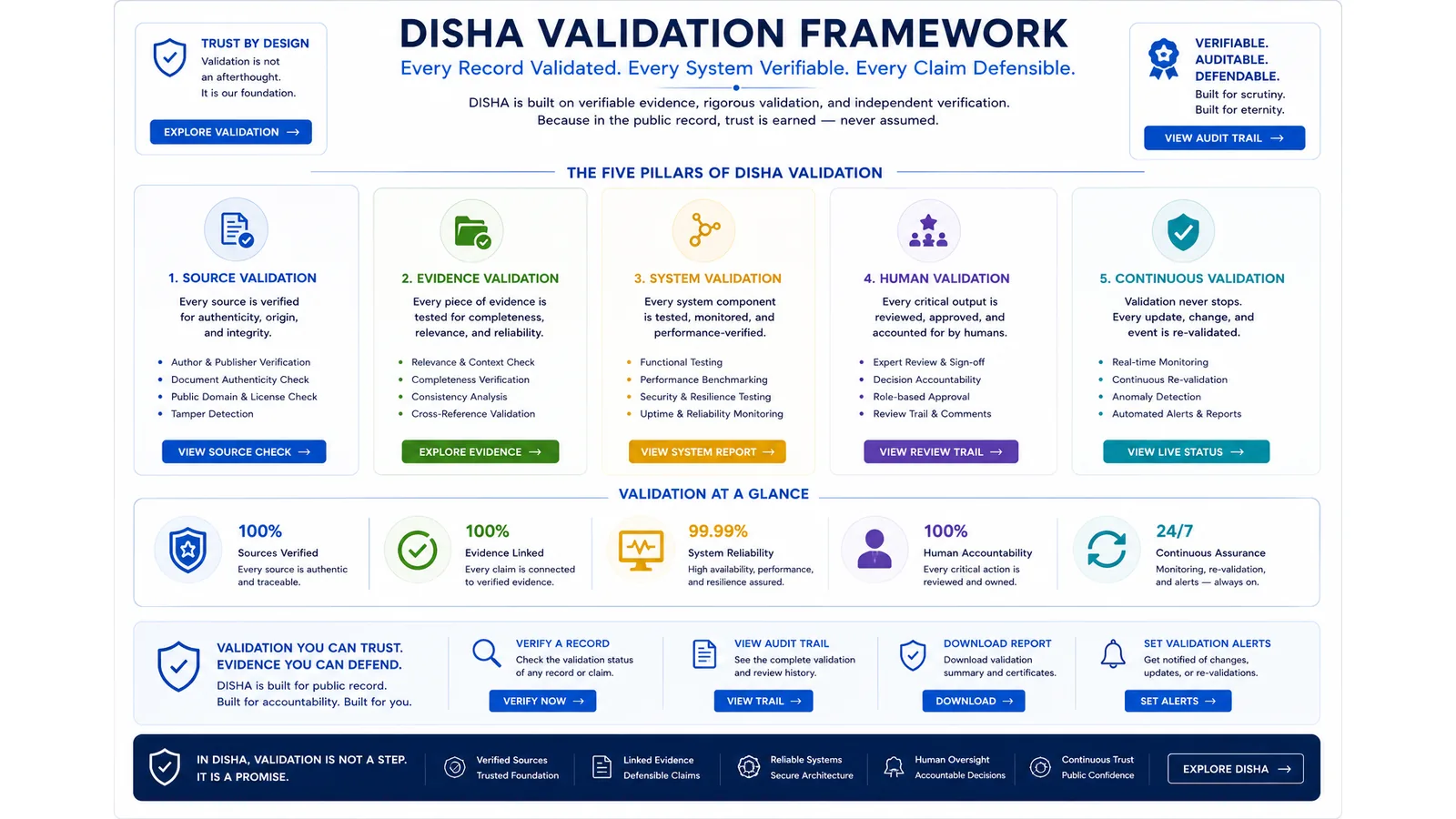
Is 97% a legal finding?
No. It is a methodological consistency figure.
DISHA public architecture
What the 97% consistency record means - and what it does not mean.

Direct Answer
The DISHA 97% figure is a methodological consistency measure. It reflects the proportion of reviewed analytical findings that remained consistent with independently available source records such as government documents, audit reports, RTI replies, court filings, official correspondence and open data. It is not a court ruling or commercial certification.
Page Facts
How this works in DISHA v6.6 runtime
DISHA does not turn every input into truth. It turns every input into a record that can be examined.
The current runtime uses a typed mission signal. A signal can include raw text, evidence files, geospatial points, threat indicators, requested action, data-source references, sensitivity, user role, device trust, action risk and telemetry risk.
Validation reviews analytical findings against available source records. A finding must be compared, classified and left open to correction if later source material changes the record.
The categories are consistent with source record, partially supported, incorrect or contradicted, and unresolved. Unresolved material should not be forced into certainty for the sake of a cleaner number.
The figure describes methodological consistency inside the reviewed set. It indicates how often reviewed findings remained consistent with available records used for comparison.
It is not a court ruling, not a commercial certification, not a claim of perfect truth and not a claim that every DISHA conclusion is final.
Research note
DISHA Validation Framework is part of the DISHA public architecture record authored by Nitish Kumar (@thenitishkr). It is written for scrutiny and source-aware reading, not blind acceptance.
Nitish Kumar (@thenitishkr). "DISHA Validation Framework." thenitishkr.in, 2026-06-29. https://thenitishkr.in/disha/validation/
Continue through DISHA
FAQ
No. It is a methodological consistency figure.
Available public records such as official documents, audit reports, RTI replies, court filings and open data.
No. Unresolved findings remain outside final certainty.
Yes. Better records can support, limit, contradict or resolve earlier findings.
Next step
Open the source discipline.