What does Yudh mean here?
It means structured threat reading, not a permission to escalate.
DISHA public architecture
Yudh reads the threat. Vyuha shapes the defence.

Direct Answer
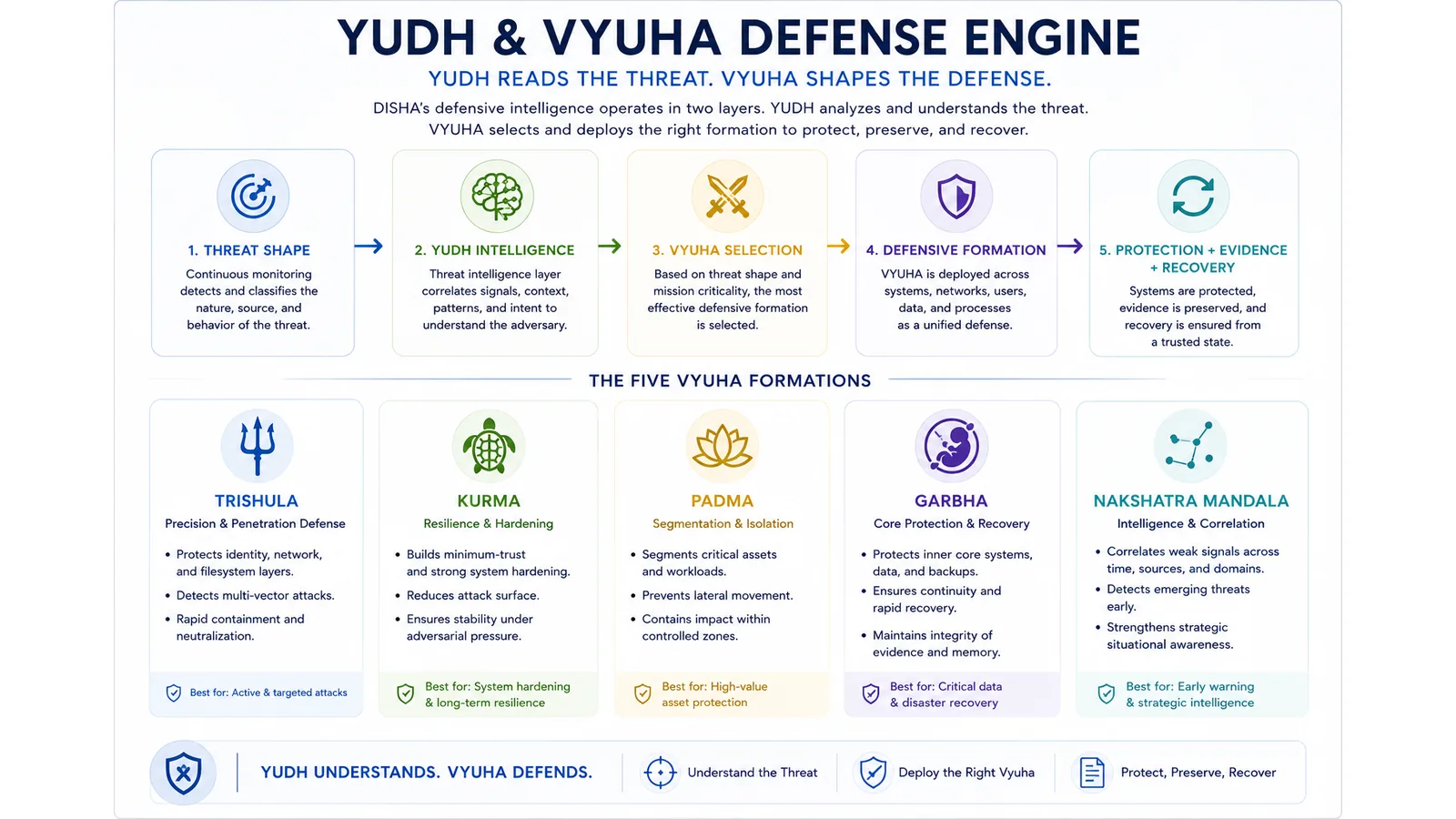
Yudh and Vyuha form DISHA's defensive cyber intelligence model. Yudh studies the shape, source, behaviour and risk of a threat. Vyuha selects a defensive formation that protects authorised systems, preserves evidence, limits harm, supports recovery and remains subject to No-First-Use restraint.
Page Facts
How this works in DISHA v6.6 runtime
DISHA does not turn every input into truth. It turns every input into a record that can be examined.
The current runtime uses a typed mission signal. A signal can include raw text, evidence files, geospatial points, threat indicators, requested action, data-source references, sensitivity, user role, device trust, action risk and telemetry risk.
Yudh names the conflict posture. It asks what is happening, which system is affected, what behaviour is visible, which evidence should be preserved and what level of authority is needed before action.
Vyuha gives the defence its shape. A formation is not a dramatic response. It is a bounded arrangement of observation, preservation, isolation, protection, recovery and review.
Trishula covers identity, network and filesystem defence. Kurma reduces exposure. Padma supports segmentation and controlled isolation. Garbha protects inner evidence and recovery. Nakshatra Mandala correlates weak signals across time and systems.
This page does not publish exploit methods, attack instructions, credentials, protected internals or restricted control logic. It explains defensive architecture and public doctrine.
Research note
Yudh & Vyuha Defense Engine is part of the DISHA public architecture record authored by Nitish Kumar (@thenitishkr). It is written for scrutiny and source-aware reading, not blind acceptance.
Nitish Kumar (@thenitishkr). "Yudh & Vyuha Defense Engine." thenitishkr.in, 2026-06-29. https://thenitishkr.in/disha/vyuha-defense-engine/
Continue through DISHA
FAQ
It means structured threat reading, not a permission to escalate.
A bounded defensive formation selected after evidence, duty, risk and authority are examined.
No. They are defensive and constrained by the No-First-Use doctrine.
A defensive event often requires several coordinated controls, not one isolated rule.
Next step
Review the No-First-Use boundary.