Is NYAYA a court?
No. It is a legal intelligence layer for mapping sources, duties and review context.
DISHA public architecture
Law participates before action.

Direct Answer
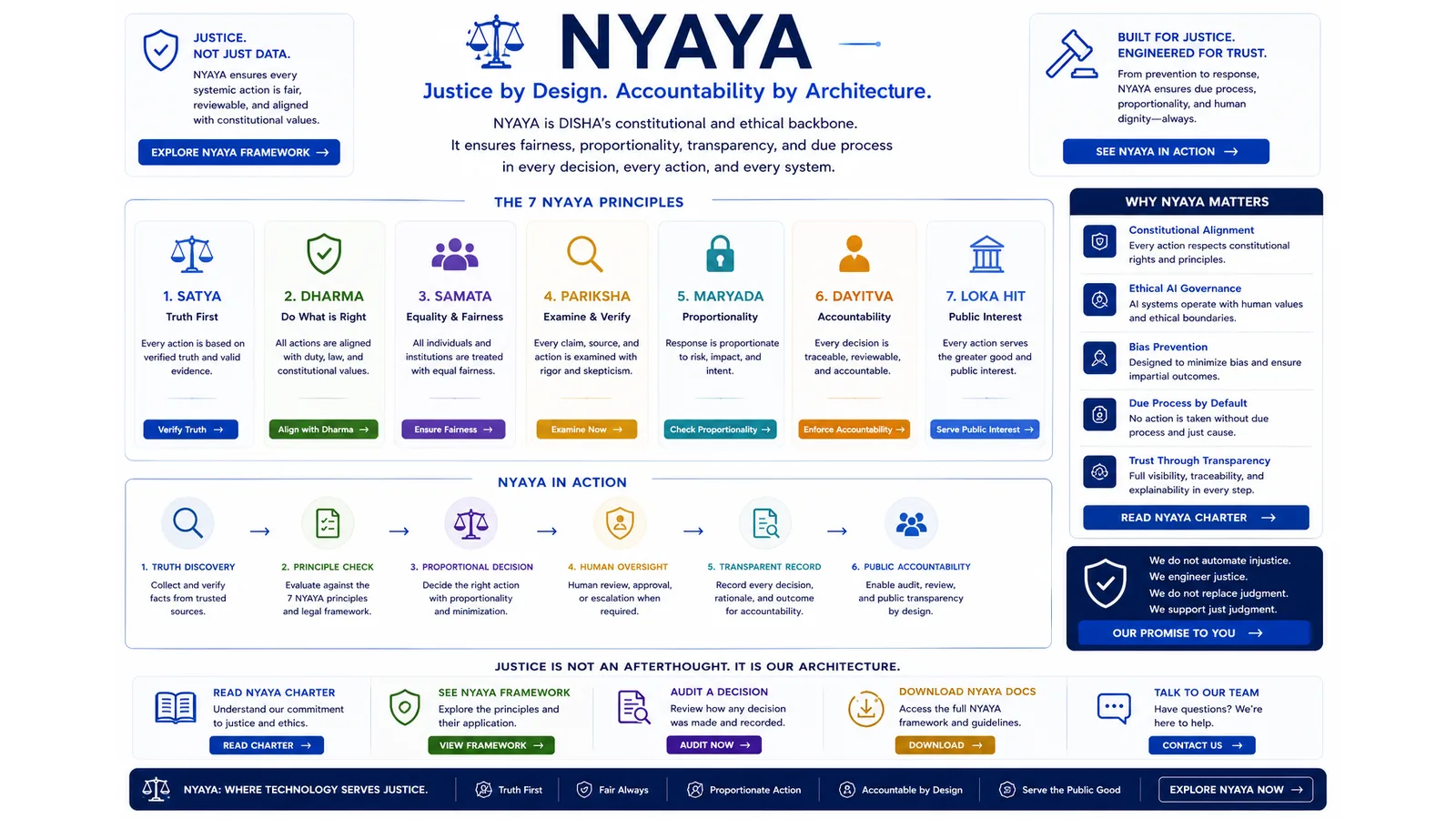
NYAYA is DISHA's constitutional and legal intelligence layer. It maps findings, actions, public authority questions and institutional responsibility against legal sources, constitutional principles, judicial records, regulations, ministry roles, evidence trails and decision history.
Page Facts
How this works in DISHA v6.6 runtime
DISHA does not turn every input into truth. It turns every input into a record that can be examined.
The current runtime uses a typed mission signal. A signal can include raw text, evidence files, geospatial points, threat indicators, requested action, data-source references, sensitivity, user role, device trust, action risk and telemetry risk.
A system that acts first and checks law later is not accountable. NYAYA exists because law must participate before action, especially when public authority, rights, records or institutional duty are involved.
NYAYA maps findings or actions to constitutional principle, judicial record, statutory source, regulatory source, ministry responsibility, evidence source, decision history and review status.
Legal intelligence should not replace legal judgment. It should preserve the map around a decision so a human reviewer can examine authority, duty, evidence and consequence.
NYAYA does not replace courts, lawyers, regulators or statutory authority. It does not claim legal finality. It preserves legal context for review.
Research note
NYAYA is part of the DISHA public architecture record authored by Nitish Kumar (@thenitishkr). It is written for scrutiny and source-aware reading, not blind acceptance.
Nitish Kumar (@thenitishkr). "NYAYA." thenitishkr.in, 2026-06-29. https://thenitishkr.in/disha/nyaya/
Continue through DISHA
FAQ
No. It is a legal intelligence layer for mapping sources, duties and review context.
No. It preserves the legal map around a finding or action.
Because public responsibility often depends on which institution held authority.
It keeps legal context attached to evidence, decision history and accountability.
Next step
Read the Article 12 public authority context.