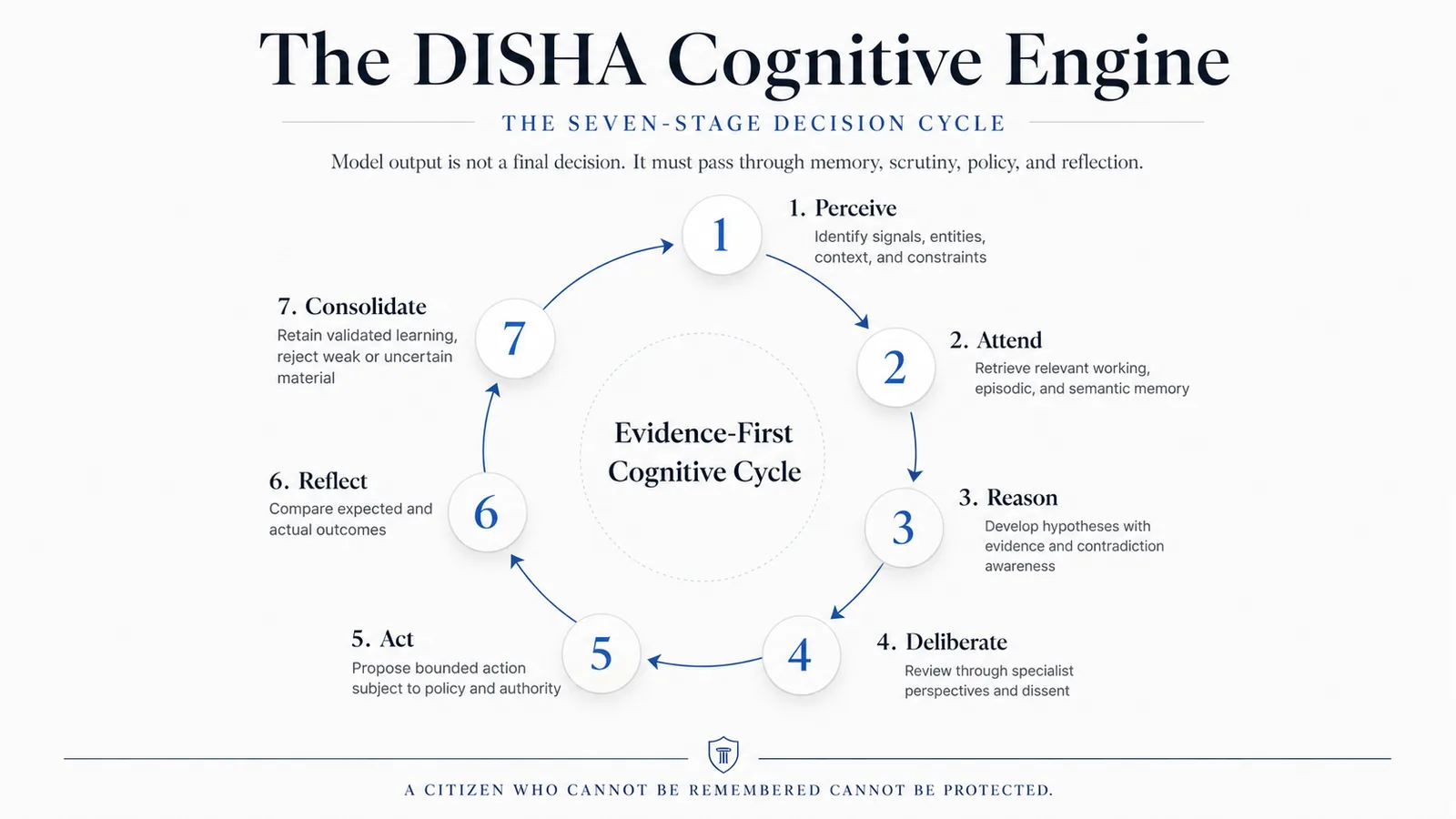
Why seven stages?
The stages separate observation, memory, reasoning, choice, action, review and learning so they do not collapse into one step.
DISHA public architecture
The seven-stage decision cycle.

Direct Answer
The DISHA cognitive engine is a seven-stage cycle that prevents machine output from becoming an instant decision. It moves through perception, attention, reasoning, deliberation, bounded action, reflection and consolidation so every conclusion remains connected to evidence, policy, memory and human review.
Page Facts
How this works in DISHA v6.6 runtime
DISHA does not turn every input into truth. It turns every input into a record that can be examined.
The current runtime uses a typed mission signal. A signal can include raw text, evidence files, geospatial points, threat indicators, requested action, data-source references, sensitivity, user role, device trust, action risk and telemetry risk.
A weak system answers too quickly. A serious system pauses. DISHA is built around that pause because public consequence should not follow a model output, alert or inference before the record has been checked.
Perceive identifies signals, entities, constraints and uncertainty. Attend retrieves relevant memory. Reason develops hypotheses. Deliberate tests alternatives. Act proposes bounded action subject to authority. Reflect compares expected and actual outcomes. Consolidate keeps only learning strong enough to become durable memory.
The cognitive engine does not remove human judgment. It creates a record around the point where human judgment is needed most: before irreversible consequence, public accusation, system restriction or formal escalation.
This page does not disclose protected internals or claim that every internal mechanism is public. It explains the public decision cycle and its accountability purpose.
Research note
The DISHA Cognitive Engine is part of the DISHA public architecture record authored by Nitish Kumar (@thenitishkr). It is written for scrutiny and source-aware reading, not blind acceptance.
Nitish Kumar (@thenitishkr). "The DISHA Cognitive Engine." thenitishkr.in, 2026-06-29. https://thenitishkr.in/disha/cognitive-engine/
Continue through DISHA
FAQ
The stages separate observation, memory, reasoning, choice, action, review and learning so they do not collapse into one step.
No high-risk action should bypass policy control and human review.
Consolidation is the step where validated learning may enter durable memory while weak material is rejected.
The public purpose is to make reasoning and evidence status reviewable.
Next step
See how policy controls action.